

Most advice on pat testing requirements Ireland gets one big thing wrong, it talks as if every portable appliance must be tested every year. That's not how the Irish system works. The actual rule is risk-based, so the right interval depends on the equipment, where it's used, how hard it's used, and its history, not a blanket calendar date.
For a landlord, business owner, or property manager in Dublin, that difference matters. It changes what you need to plan, what you need to document, and what you need to challenge when someone tries to sell you a one-size-fits-all schedule. It also explains why PAT testing is part compliance, part recordkeeping, and part sensible maintenance.
Table of Contents
- The Truth About PAT Testing in Ireland
- Legal Framework and Regulatory Requirements
- What Adequate Inspection and Testing Involves
- Risk-Based Testing Frequencies by Equipment and Environment
- Recordkeeping and Documentation Requirements
- Common Exemptions and Edge Cases
- Compliance Checklist and Next Steps
The Truth About PAT Testing in Ireland
The first thing to get straight is this, Irish law doesn't create a universal annual PAT rule. The legal framework points you towards periodic inspection and testing by a competent person, then leaves the interval to risk assessment and the conditions on site.
That matters because a tidy office printer and a kettle in a busy staff kitchen do not carry the same risk. The law reflects that reality. A low-risk item that sits still in a clean environment can justify a very different schedule from hand tools, heaters, or equipment used in damp, crowded, or high-wear settings.
What that means in practice
If you're a landlord or business owner, PAT testing should not be treated as a tick-box job you do once and forget. It is an ongoing control, and the interval should make sense for the appliance and the environment. Irish guidance on Irish electrical regulations and compliance reflects the same principle, with office equipment often taking a much longer interval than equipment used by the public or on construction sites.
Practical rule: if you cannot explain why an appliance is on that testing cycle, you probably do not have a defensible cycle yet.
That is the difference between over-testing and proper compliance. Over-testing wastes time and money on low-risk items. Under-testing leaves gaps where faults can sit unnoticed until someone finds them the hard way. For employers, the point is not just to pass a test, it is to be able to show a sensible system when the HSA asks questions.
If you have only ever heard “annual PAT testing”, keep reading, because that shortcut can lead to poor decisions in both directions. The better question is whether your current setup can be justified on risk, usage, and records.
Legal Framework and Regulatory Requirements
Irish PAT obligations come from the Safety, Health and Welfare at Work Act 2005 and the Safety, Health and Welfare at Work (General Application) Regulations 2007, S.I. No. 299, which came into force in November 2007. The practical duty sits with employers and other duty holders, who must make sure portable equipment used in the workplace is periodically inspected and tested by a competent person. That framework is set out in the legislation summary at PATCert, and the wider compliance context is covered in Forward Electrical's Irish electrical regulations page.
The key point is that the regulations focus on workplace safety, not on one universal interval that suits every appliance. Compliance is not just booking a test and archiving the invoice. It means assessing risk, setting a sensible inspection cycle, and showing that unsafe equipment is taken out of use until it is made safe and recertified.
What employers have to do
The Irish regime creates a clear chain of responsibility. The employer identifies the equipment, the competent person inspects and tests it, and the records show what was checked and when. Where a certificate shows the equipment was not safe on the day of inspection, it has to be removed from use until it is made safe and recertified.
That is why PAT testing works as a governance tool as much as a safety check. It gives you evidence during an HSA inspection. It also gives you a defensible trail if a tenant, employee, insurer, or contractor asks what was done and when.
The document trail matters
Irish rules require inspection and test records to be kept for 5 years. That retention period turns PAT from a one-off maintenance job into an audit-ready control system, because you need to show continuity, not just a current certificate. In practice, you should be able to find the appliance, the result, the date, and the person who carried it out.
If the records are messy, the testing programme usually is too.
That is the standard I would use on a real job in Dublin. The law sets the framework. Good records show you have applied it.
What Adequate Inspection and Testing Involves
A proper PAT visit starts with a visual inspection, because many faults show up before any meter is used. The person doing the work needs to understand electrical, mechanical, and thermal damage, know the appliance class, and have enough experience to judge whether the item is still safe to keep in service, according to PAT Testers' guidance on who can carry out PAT testing.

For portable equipment supplied at a voltage exceeding 125 volts AC, the same source says it should be inspected and, where appropriate, tested, with a certificate confirming that the equipment, including cables and plug-tops, was safe on the day of inspection as far as could reasonably be ascertained. That wording matters in real paperwork. It shows the condition at the time of testing, not a vague “all good” note that will not help you if an HSA inspector, insurer, or tenant asks for proof.
What a competent person looks for
A competent person is not just someone holding a tester. They need enough background to spot damage, interpret the results, and understand what matters for the appliance class. Irish guidance from DWSFS sets out the practical split between checks, with Class I items generally requiring earth continuity and insulation resistance checks, while Class II items focus on insulation integrity because they do not have a protective earth.
That distinction affects the job on site. A kettle, a desk lamp, and a double-insulated charger do not get treated the same way, even if they sit in the same office, rental property, or workshop. For a plain-English breakdown of the process, Forward Electrical's explanation of PAT testing is a useful reference point.
What you should expect to receive
A decent testing visit should leave you with more than a sticker on a plug. You should get a certificate or report that identifies the appliance, the date, the result, and the person who tested it. You should also expect any failed item to be clearly marked and removed from use until it is fixed and re-tested.
That paperwork is the point of the exercise. For businesses, it is the record that supports your position in an inspection or dispute. For landlords, it shows you took reasonable steps. For managers, it becomes the basis for the next testing cycle and helps keep the programme tidy enough to stand up to scrutiny.
Risk-Based Testing Frequencies by Equipment and Environment
Ireland does not use one fixed statutory interval for every appliance, and that is where a lot of people get caught out. The HSA approach is risk-based, so the right interval depends on the equipment, the environment, how often it is used, and its past condition. The practical guidance in circulation, including construction-focused advice from DLS Safety, shows that spread clearly.
Typical intervals by context
| Equipment Type | Environment | Recommended Interval |
|---|---|---|
| Office equipment | Low-risk office setting | 2 to 5 years |
| Equipment used by the public | Public-facing environment | 12 months |
| Portable tools and equipment | Active construction site | Every 3 months |
The table is a guide, not a substitute for judgment on the ground. A low-risk office workstation can justify a longer cycle, while a public-facing appliance or a site tool needs tighter attention because it sees more handling, more wear, and more exposure.
Why the environment changes everything
Heat, moisture, vibration, and frequent handling all increase the chance of damage. A back-office charger and a site saw should never sit on the same testing timetable. The guidance used in practice makes the same point, with frequency shaped by appliance type, usage intensity, environment, and history.
Good scheduling is conservative where the risk is higher, and less frequent where the risk is genuinely low.
For construction and multi-site commercial work, shorter cycles usually make sense for temporary tools, 110V site equipment, and anything that moves from one location to another. The same approach applies to retail rollouts, hospitality refurbishments, and short-term fit-outs in Dublin, where contractors, temporary leads, and heavy footfall all add to wear.
Annual testing is not a universal answer. It can be too much in one setting and not enough in another. A landlord with low-risk office equipment can often justify a longer interval if the condition record supports it. A workshop, a busy shop floor, or a damp site pushes the other way, because the use pattern and environment increase the risk of failure.
Recordkeeping and Documentation Requirements

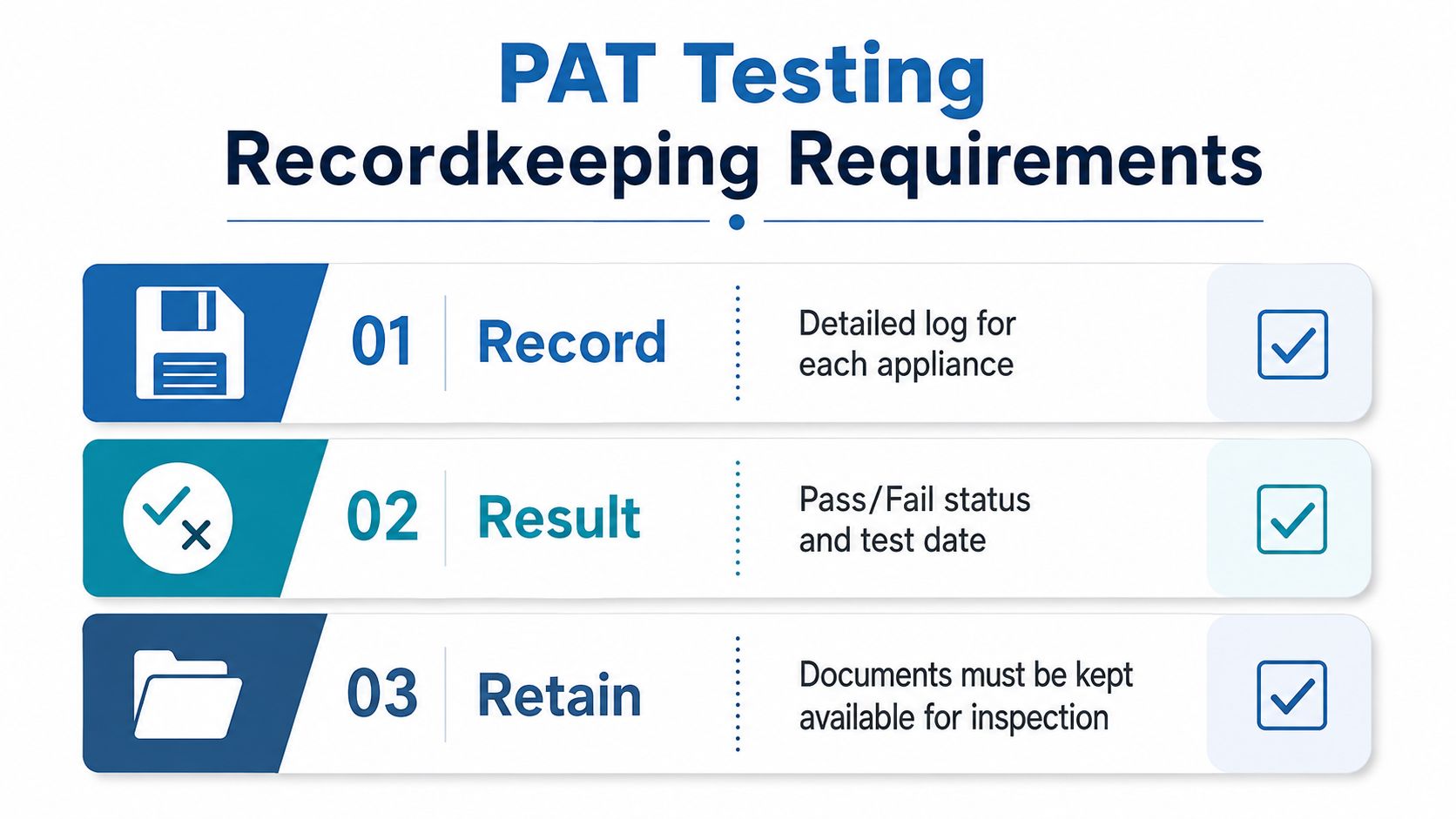
Good PAT records are what let you prove the work was done properly. In practice, that means keeping a clear trail for each appliance, each inspection, and each decision made after a failed result. A graphic outlining PAT testing recordkeeping requirements including documenting logs, test results, and maintaining accessible inspection records.
What the file should show
At a minimum, the record should identify the appliance, note the date it was checked, state the result, and name the person who carried out the work. A certificate or log entry that ties the result to a specific inspection date is far more useful than a loose note saying the item was “checked.”
A failed item needs a clear paper trail too. The log should show that it failed, what happened next, and whether it was taken out of use, repaired, or retested. That matters because equipment that is not safe on the day cannot stay in service on the strength of a shrug and a promise to fix it later.
A good digital system keeps this tidy without much effort. Each appliance should have its own entry, with photos, test results, follow-up notes, and any repair history stored in one place. If a landlord or business owner is managing several sites, separate folders or site tags help prevent confusion between offices, apartments, shops, and storage areas.
How good records help in real life
Clean records do more than satisfy an inspection. They show that the person in charge took reasonable care, and they give you something solid to point to if a dispute arises after a fault or incident.
They also make day-to-day management easier. If you have multiple premises around Dublin, the system should let you see what was tested, what failed, what was repaired, and what still needs attention without digging through loose certificates or old emails.
Digital records are usually easier to search, sort, and back up than paper files, but the format is not the main issue. A messy spreadsheet with missing entries is no better than an untidy folder. What matters is that the trail is complete, readable, and easy to produce when someone asks for proof.
Common Exemptions and Edge Cases
Not every item on a premises needs PAT testing. One of the most useful Irish nuances is that equipment that's rarely moved and protected from damage should not need to be tested unless a risk assessment shows otherwise, according to TU Dublin guidance used in Irish PAT arrangements. That's a useful counterweight to the blanket annual testing myth, and it stops people wasting time on items that aren't really in scope.
What usually falls outside the PAT conversation
Fixed installations are a different issue from portable appliances, so don't mix the two up. A hardwired system, a distribution arrangement, or other fixed electrical work belongs in a different compliance bucket. PAT testing is aimed at portable items, the sort of things you plug in and move around.
New equipment also gets misunderstood. Being new doesn't make an appliance exempt forever, but it can influence the risk picture if the item is low-risk, undamaged, and used in a controlled setting. Battery-powered devices can fall outside normal plug-in PAT thinking, though they still need a sensible safety review where they're being used around staff, tenants, or contractors.
Domestic, landlord, and contractor situations
Homeowners often ask whether every appliance in the house needs to be tested. In a normal domestic setting, that's not how Irish workplace PAT rules operate. Landlords need to think more carefully about what they supply in rental property, while businesses need to look at employee use, visitor use, and contractor equipment separately.
Practical point: if you don't own the appliance, and it's not part of your workplace supply, it usually isn't your PAT responsibility.
That doesn't mean you ignore it. It means you separate ownership, location, and duty of care before you book a test. For example, landlord-supplied items in a rental unit deserve a different approach from a tenant's own charger or laptop. Contractor tools are again different, especially where several firms are on site and temporary electrics are being used.
A proper assessment saves money. You only test what falls within the scope, and you set the interval according to risk instead of habit.
Compliance Checklist and Next Steps
If you want a defensible PAT system in Dublin, keep it simple and organised. Start with a risk assessment, then work outward from there. A sensible programme is easier to maintain than a rushed annual batch of tests no one can explain later.

A practical checklist
- Identify the appliances: List the portable equipment you control, including landlord-provided items, staff equipment, and site tools.
- Set the risk level: Look at how often the item is used, where it's used, and whether it gets moved, handled, or exposed to moisture.
- Choose a competent person: Use someone who understands the equipment class, the risks, and the required documentation.
- Build the schedule: Match the interval to the risk profile, not to a generic annual rule.
- Keep the records: Hold onto certificates and test logs for 5 years so you can produce them if needed.
- Review the plan: Revisit the schedule when the environment changes, new equipment arrives, or an item fails.
If you need a provider, choose a contractor who can explain the rationale behind the schedule, not just the test itself. In Dublin and North County Dublin, that usually means a Safe Electric registered team that understands Irish compliance and issues paperwork you can use. You can also check Forward Electrical's electrical contractors registration page if you're comparing what a registered contractor should be able to provide.
When a business or landlord gets this right, PAT testing stops being a headache. It becomes a routine safety control that fits the property instead of fighting it. If you're unsure what applies to your premises, or you've got mixed equipment across offices, apartments, or worksites, arrange a professional assessment before the next inspection catches you out. For practical help with testing, records, and compliance in Dublin, visit Forward Electrical and talk to a qualified electrician who works with Irish regulations every day.