Electrical Contractors Dublin: A Complete Hiring Guide

You've got a renovation starting, a tenant moving in, or a circuit that keeps tripping, and you need an electrician you can trust. In Dublin, the first name that appears online isn't automatically the safest choice. Electrical work affects people, property, insurance records, and legal compliance, so hiring should involve more than comparing who can arrive fastest.

The right electrical contractors in Dublin will assess the installation properly, explain what needs attention, carry out work to Irish requirements, and provide the correct documentation where certification applies. This guide focuses on the practical checks that reduce risk for homeowners, landlords, property managers, and businesses.

Table of Contents

Why Choosing the Right Electrical Contractor Matters

A Dublin homeowner might call an electrician after noticing flickering lights in a terraced house, a warm socket in a converted attic, or repeated trips at the consumer unit. A landlord may need work completed before a new tenancy, while a café owner might need a fault resolved without disrupting trading. These situations look different, but they share one problem: you can't judge electrical workmanship by appearance alone.

Older Dublin homes can contain wiring and alterations from different periods. Extensions, attic conversions, electric showers, additional sockets, and modern appliances may all have been added at different times. A neat faceplate doesn't confirm that the circuit is correctly protected, that earthing and bonding are suitable, or that earlier work was documented.

Commercial premises bring another layer of complexity. Retail units, offices, restaurants, and managed buildings need electrical systems that support staff, customers, equipment, emergency arrangements, and business continuity. A contractor who mainly handles small domestic repairs may not be the right fit for a commercial fit-out or planned maintenance programme.

The lowest quote can create the highest uncertainty

Price matters, but a low quote can exclude the checks and paperwork that protect you. Two contractors may appear to offer the same job while allowing for very different levels of inspection, testing, access, remedial work, materials, and certification.

Practical rule: Compare what each quotation includes, not just the figure at the bottom.

A responsible contractor should clarify the scope, identify assumptions, and explain what happens if testing reveals an unsafe defect. That approach may feel slower than accepting a quick promise over the phone, but it gives you a clearer decision and fewer surprises.

Safety has to lead the hiring decision

The Health and Safety Authority warns that electrical installations can kill, injure people, and cause serious property damage when they aren't properly maintained. Its guidance on inspection and testing also links ongoing inspection to Regulation 89 of the General Application Regulations, making maintenance a practical responsibility rather than an optional improvement. The HSA's guidance on I.S. 10101 and inspection is useful background for anyone responsible for a property.

Ireland's market is regulated for good reason. A contractor needs to understand the installation as a complete system, not just replace the visible component that has failed. For Dublin property owners, the better question isn't “Can someone fix this quickly?” It's “Can this person diagnose the cause, make the installation safe, and leave a traceable record of the work?”

Verifying Safe Electric Registration and Credentials

For domestic electrical work in Ireland, registration is the starting point. The Commission for Regulation of Utilities states that anyone carrying out electrical work in a domestic setting must register with Safe Electric. Safe Electric maintains the official register of Registered Electrical Contractors and audits contractors against national standards and technical rules. Safe Electric's contractor information explains why registered status matters to both contractors and customers.

Ask for the contractor's registration details before work begins, then check them independently. Don't rely only on a logo in an advert or an assurance that someone is “qualified”.

What the registration pathway involves

Safe Electric's requirements include a nominated Qualified Certifier with a recognised electrical qualification at Level 6 or higher on the National Framework of Qualifications. The certifier must also complete the Verification and Certification of Electrical Installations course, and the contractor must provide valid insurance documentation. The certificate is valid for 5 years, as set out in the registration information from Safe Electric. The registration requirements are outlined by Safe Electric.

That structure gives customers meaningful information. Registration isn't just a marketing label. It connects qualifications, verification and certification training, insurance, inspection, audit, and technical competence.

A five-step guide on how to verify the registration of an electrical contractor using Safe Electric.

A simple hiring check

Use this sequence when speaking with an electrician:

  1. Confirm registration: Ask for the Safe Electric registration number and the contractor's legal trading details.
  2. Check the official register: Search Safe Electric rather than relying on a screenshot or copied certificate.
  3. Match the work to the contractor: Explain whether the job involves a repair, new circuit, consumer unit, rewiring, commercial installation, or EV charger.
  4. Ask about insurance: Request confirmation that relevant insurance is current.
  5. Confirm certification: Before accepting the quotation, ask what certificate or report you'll receive after the work.

A useful next step is to understand what a Registered Electrical Contractor does, particularly if you're appointing someone for controlled work or managing several properties.

Safe Electric also advises customers to check the register before hiring. That recommendation matters because registered status supports buyer due diligence, especially in a busy Dublin market where property owners may be comparing several contractors under time pressure.

Navigating Compliance and Required Certification Paperwork

Electrical paperwork becomes important when the job affects the safety or configuration of an installation. In Ireland, a Registered Electrical Contractor must issue a Completion Certificate for all electrical works except minor works, under the Electricity Regulation Act 1999 as amended. Safe Electric explains that the certification system helps monitor whether completed work meets the National Rules for Electrical Installations, while the CRU advises homeowners to ask for a completion certificate after work in the home. Safe Electric's completion certificate guidance sets out this responsibility.

That distinction is often missed in generic searches for electrical contractors Dublin. A contractor may describe a job as a repair, but the customer still needs to know whether the work falls within a category requiring formal certification.

Controlled Works and minor works

Certificates for Controlled Works can only be issued by a Registered Electrical Contractor or a Safety Supervisory Body inspector, according to the HSA guidance cited in Safe Electric's FAQ. The exact treatment depends on the work and the installation, so a contractor should confirm the certification position before starting rather than leaving it until the final invoice. Safe Electric's FAQ explains certification responsibilities.

A consumer unit upgrade, rewiring project, new circuit, or significant alteration deserves a clear answer about documentation. A minor repair may not require the same certificate, but that doesn't remove the need for safe isolation, competent assessment, and appropriate records.

The professional workflow

For an existing installation, Safe Electric recommends periodic inspection and testing to verify compliance. A sensible contractor workflow is to confirm the scope, test the installation, record defects using the relevant code system, complete the condition report, and retain documentation for future audits. New installations should be designed and certified to I.S. 10101:2020, the National Rules for Electrical Installations. The HSA explains the relationship between I.S. 10101 and inspection.

Certification shouldn't be treated as an administrative afterthought. It records what was inspected, what was installed, and what defects required attention. For landlords, letting agents, and commercial clients, that audit trail can be as important as the physical repair.

If you need a clearer explanation of the documentation commonly requested after electrical work, review this guide to an electrical safety certificate in Dublin. Ask your contractor to identify the document before approving the job, not after the work is complete.

Comparing Domestic and Commercial Electrical Requirements

A homeowner and a facility manager may both need an electrician, but they're hiring for different operating conditions. Domestic work often centres on safe repairs, upgrades, inspections, kitchen renovations, rewiring, lighting, and the realities of older housing. Commercial work has to account for staff, customers, equipment, trading hours, records, access restrictions, and coordinated construction schedules.

A contractor's experience should match the environment. Domestic competence doesn't automatically mean a team is prepared for a retail rollout, a hospitality fit-out, or a multi-occupancy office building.

A comparison chart outlining the key differences between domestic and commercial electrical installation and maintenance needs.

Domestic properties need careful assessment

In a Dublin terraced house or older semi-detached property, the visible problem may not reveal the underlying condition. A renovation can expose outdated wiring, incomplete alterations, overloaded circuits, or labelling that no longer matches the installation. Kitchen projects deserve early electrical planning because ovens, hobs, dishwashers, refrigeration, lighting, sockets, and extraction can all affect the design.

Homeowners should look for a contractor who explains disruption clearly and separates urgent safety work from optional improvements. A proper inspection may identify defects that aren't part of the original request, but the contractor should explain their significance rather than using alarming language to sell unnecessary work.

Commercial premises need coordination

Commercial clients often require a planned method of working. The electrician may need to coordinate with builders, shopfitters, landlords, fire-safety specialists, IT contractors, and building managers. Emergency lighting, distribution, access, isolation windows, testing records, and handover documentation can all form part of the brief.

Domestic priority Commercial priority
Protect occupants and property Protect occupants, staff, customers, and operations
Adapt work to household access Coordinate work around trading or office use
Resolve faults and plan upgrades Deliver installation, maintenance, testing, and handover records
Keep disruption manageable Control programme, access, safety, and business continuity

A business should explain its operating hours and any critical equipment before the quotation is prepared. That gives the contractor a chance to plan isolations and identify where temporary arrangements or phased work may be required.

For offices, retail units, hospitality venues, and property portfolios, Forward Electrical's commercial electrical services cover the type of planned and reactive work that needs a different level of coordination from a standard domestic call-out.

Managing Electrical Emergencies and Future-Proofing Upgrades

A breaker that trips repeatedly should be treated as a fault warning, not a nuisance to reset. Power may return briefly, but the underlying cause could involve an appliance, wiring, a protective device, moisture, overloading, or a developing defect. Burning odours, buzzing, visible damage, smoke, or repeated power loss require a cautious response. Keep people away from the affected area and contact a qualified electrician.

A professional electrician wearing protective gloves working on a modern electrical circuit breaker panel in Dublin.

A dependable emergency service should make the installation safe, investigate the fault where possible, explain any temporary restrictions, and state whether further testing or remedial work is required. Business premises may also need a response that protects staff and customers while considering refrigeration, security systems, data equipment, and opening hours.

Emergency response should connect to planned work

An emergency call-out does not always end with a permanent repair on the same visit. Parts, access, coordination, or a wider inspection may be needed. The contractor should record what was found, explain what remains unresolved, and provide a sensible next step instead of leaving the customer to repeat the same reset.

A fast response is valuable, but a clear diagnosis is what prevents the same emergency from returning.

Future-proofing applies the same discipline to planned improvements. Dublin property owners may be considering EV charging, electric heating, larger appliances, smart controls, or upgraded lighting. These additions can increase demand on an existing installation, so the electrician should assess capacity, protective arrangements, distribution, cable routes, and the order in which later upgrades may be completed.

EV charging is an infrastructure decision

An EV charger is part of the property's electrical system, not just a product fixed to a wall. The contractor should review available capacity, charger position, cable routing, protection, certification, and the way other loads may operate at the same time. A house, rental property, office, retail unit, or apartment development may each require a different arrangement.

Irish compliance requirements also matter. NSAI's National Rules FAQ directs users to Safe Electric for Registered Electrical Contractors. The wiring rules reference has been updated through A1:2024, with a further AC2:2025 corrigendum, as noted in relevant industry information. Qualified.ie's Dublin contractor listing also reflects the distinction between general electrical work and specialist areas such as EV charging.

For a visual introduction to electrical work during an upgrade or inspection, see this electrical upgrade and inspection video.

A contractor who links emergency fault-finding with capacity planning provides more useful long-term guidance than one-off repairs alone. The immediate fault is addressed, and future changes can be assessed before they create another interruption. For Dublin property owners, using a registered contractor also supports the certification and safety records needed when regulated work is carried out.

How Forward Electrical Delivers Certified and Reliable Service

A low-risk hiring decision combines registration, technical competence, communication, documentation, and an honest assessment of the property. Forward Electrical is a Dublin-based contractor with a RECI-qualified, Safe Electric registered team and over 10 years' experience, serving domestic, commercial, and emergency customers across Dublin and North County Dublin.

That range matters because property needs rarely stay inside one category. A homeowner may need fault-finding now and rewiring later. A landlord may need inspection, remedial work, and certification across several properties. A business may move from an urgent outage to planned maintenance, lighting, EV charging, or a wider fit-out.

What customers should expect from the service

Forward Electrical's work includes domestic repairs, consumer unit upgrades, rewiring, lighting, data points, EV charger installations, commercial fit-outs, planned maintenance, and emergency call-outs. The team also provides fast, out-of-hours emergency response across Dublin and North County Dublin for issues such as tripping circuits and power outages.

The practical standards are straightforward:

  • Clear communication: The scope, limitations, and next steps should be explained in plain English.
  • Tidy workmanship: Work areas should be kept organised and left in a suitable condition.
  • Punctual attendance: Access arrangements and project timing should be respected.
  • Proper records: Certified work should be supported by the appropriate documentation.
  • Suitable planning: Domestic and commercial installations should be assessed for their actual loads and future requirements.

Forward Electrical also offers transparent pricing and free consultations. That gives homeowners, landlords, facility managers, contractors, and business owners an opportunity to discuss the installation before committing to a course of action.

The wider safety record reinforces why these checks matter. Safe Electric reported 38 electrical fatalities in Ireland between 2001 and 2015, an average of 2.5 per year, compared with 2 fatalities between 2016 and 2020, an average of 0.4 per year, and zero fatalities in 2018, 2019, and 2020. Safe Electric's newsletter records this comparison. The figures don't remove the need for professional judgement, but they underline why registered workmanship, inspection, testing, and certification deserve serious attention.


Forward Electrical provides certified domestic, commercial, and emergency electrical services throughout Dublin and North County Dublin, from fault-finding and rewiring to fit-outs, EV charging, inspections, and planned upgrades. Visit Forward Electrical to arrange a consultation and discuss the safest, most practical way to address your electrical requirements.

PAT Testing Requirements Ireland: A Practical Guide

Most advice on pat testing requirements Ireland gets one big thing wrong, it talks as if every portable appliance must be tested every year. That's not how the Irish system works. The actual rule is risk-based, so the right interval depends on the equipment, where it's used, how hard it's used, and its history, not a blanket calendar date.

For a landlord, business owner, or property manager in Dublin, that difference matters. It changes what you need to plan, what you need to document, and what you need to challenge when someone tries to sell you a one-size-fits-all schedule. It also explains why PAT testing is part compliance, part recordkeeping, and part sensible maintenance.

Table of Contents

The Truth About PAT Testing in Ireland

The first thing to get straight is this, Irish law doesn't create a universal annual PAT rule. The legal framework points you towards periodic inspection and testing by a competent person, then leaves the interval to risk assessment and the conditions on site.

That matters because a tidy office printer and a kettle in a busy staff kitchen do not carry the same risk. The law reflects that reality. A low-risk item that sits still in a clean environment can justify a very different schedule from hand tools, heaters, or equipment used in damp, crowded, or high-wear settings.

What that means in practice

If you're a landlord or business owner, PAT testing should not be treated as a tick-box job you do once and forget. It is an ongoing control, and the interval should make sense for the appliance and the environment. Irish guidance on Irish electrical regulations and compliance reflects the same principle, with office equipment often taking a much longer interval than equipment used by the public or on construction sites.

Practical rule: if you cannot explain why an appliance is on that testing cycle, you probably do not have a defensible cycle yet.

That is the difference between over-testing and proper compliance. Over-testing wastes time and money on low-risk items. Under-testing leaves gaps where faults can sit unnoticed until someone finds them the hard way. For employers, the point is not just to pass a test, it is to be able to show a sensible system when the HSA asks questions.

If you have only ever heard “annual PAT testing”, keep reading, because that shortcut can lead to poor decisions in both directions. The better question is whether your current setup can be justified on risk, usage, and records.

Legal Framework and Regulatory Requirements

Irish PAT obligations come from the Safety, Health and Welfare at Work Act 2005 and the Safety, Health and Welfare at Work (General Application) Regulations 2007, S.I. No. 299, which came into force in November 2007. The practical duty sits with employers and other duty holders, who must make sure portable equipment used in the workplace is periodically inspected and tested by a competent person. That framework is set out in the legislation summary at PATCert, and the wider compliance context is covered in Forward Electrical's Irish electrical regulations page.

The key point is that the regulations focus on workplace safety, not on one universal interval that suits every appliance. Compliance is not just booking a test and archiving the invoice. It means assessing risk, setting a sensible inspection cycle, and showing that unsafe equipment is taken out of use until it is made safe and recertified.

What employers have to do

The Irish regime creates a clear chain of responsibility. The employer identifies the equipment, the competent person inspects and tests it, and the records show what was checked and when. Where a certificate shows the equipment was not safe on the day of inspection, it has to be removed from use until it is made safe and recertified.

That is why PAT testing works as a governance tool as much as a safety check. It gives you evidence during an HSA inspection. It also gives you a defensible trail if a tenant, employee, insurer, or contractor asks what was done and when.

The document trail matters

Irish rules require inspection and test records to be kept for 5 years. That retention period turns PAT from a one-off maintenance job into an audit-ready control system, because you need to show continuity, not just a current certificate. In practice, you should be able to find the appliance, the result, the date, and the person who carried it out.

If the records are messy, the testing programme usually is too.

That is the standard I would use on a real job in Dublin. The law sets the framework. Good records show you have applied it.

What Adequate Inspection and Testing Involves

A proper PAT visit starts with a visual inspection, because many faults show up before any meter is used. The person doing the work needs to understand electrical, mechanical, and thermal damage, know the appliance class, and have enough experience to judge whether the item is still safe to keep in service, according to PAT Testers' guidance on who can carry out PAT testing.

An infographic illustrating the three steps of PAT testing: visual inspection, electrical testing, and using a competent person.

For portable equipment supplied at a voltage exceeding 125 volts AC, the same source says it should be inspected and, where appropriate, tested, with a certificate confirming that the equipment, including cables and plug-tops, was safe on the day of inspection as far as could reasonably be ascertained. That wording matters in real paperwork. It shows the condition at the time of testing, not a vague “all good” note that will not help you if an HSA inspector, insurer, or tenant asks for proof.

What a competent person looks for

A competent person is not just someone holding a tester. They need enough background to spot damage, interpret the results, and understand what matters for the appliance class. Irish guidance from DWSFS sets out the practical split between checks, with Class I items generally requiring earth continuity and insulation resistance checks, while Class II items focus on insulation integrity because they do not have a protective earth.

That distinction affects the job on site. A kettle, a desk lamp, and a double-insulated charger do not get treated the same way, even if they sit in the same office, rental property, or workshop. For a plain-English breakdown of the process, Forward Electrical's explanation of PAT testing is a useful reference point.

What you should expect to receive

A decent testing visit should leave you with more than a sticker on a plug. You should get a certificate or report that identifies the appliance, the date, the result, and the person who tested it. You should also expect any failed item to be clearly marked and removed from use until it is fixed and re-tested.

That paperwork is the point of the exercise. For businesses, it is the record that supports your position in an inspection or dispute. For landlords, it shows you took reasonable steps. For managers, it becomes the basis for the next testing cycle and helps keep the programme tidy enough to stand up to scrutiny.

Risk-Based Testing Frequencies by Equipment and Environment

Ireland does not use one fixed statutory interval for every appliance, and that is where a lot of people get caught out. The HSA approach is risk-based, so the right interval depends on the equipment, the environment, how often it is used, and its past condition. The practical guidance in circulation, including construction-focused advice from DLS Safety, shows that spread clearly.

Typical intervals by context

Equipment Type Environment Recommended Interval
Office equipment Low-risk office setting 2 to 5 years
Equipment used by the public Public-facing environment 12 months
Portable tools and equipment Active construction site Every 3 months

The table is a guide, not a substitute for judgment on the ground. A low-risk office workstation can justify a longer cycle, while a public-facing appliance or a site tool needs tighter attention because it sees more handling, more wear, and more exposure.

Why the environment changes everything

Heat, moisture, vibration, and frequent handling all increase the chance of damage. A back-office charger and a site saw should never sit on the same testing timetable. The guidance used in practice makes the same point, with frequency shaped by appliance type, usage intensity, environment, and history.

Good scheduling is conservative where the risk is higher, and less frequent where the risk is genuinely low.

For construction and multi-site commercial work, shorter cycles usually make sense for temporary tools, 110V site equipment, and anything that moves from one location to another. The same approach applies to retail rollouts, hospitality refurbishments, and short-term fit-outs in Dublin, where contractors, temporary leads, and heavy footfall all add to wear.

Annual testing is not a universal answer. It can be too much in one setting and not enough in another. A landlord with low-risk office equipment can often justify a longer interval if the condition record supports it. A workshop, a busy shop floor, or a damp site pushes the other way, because the use pattern and environment increase the risk of failure.

Recordkeeping and Documentation Requirements

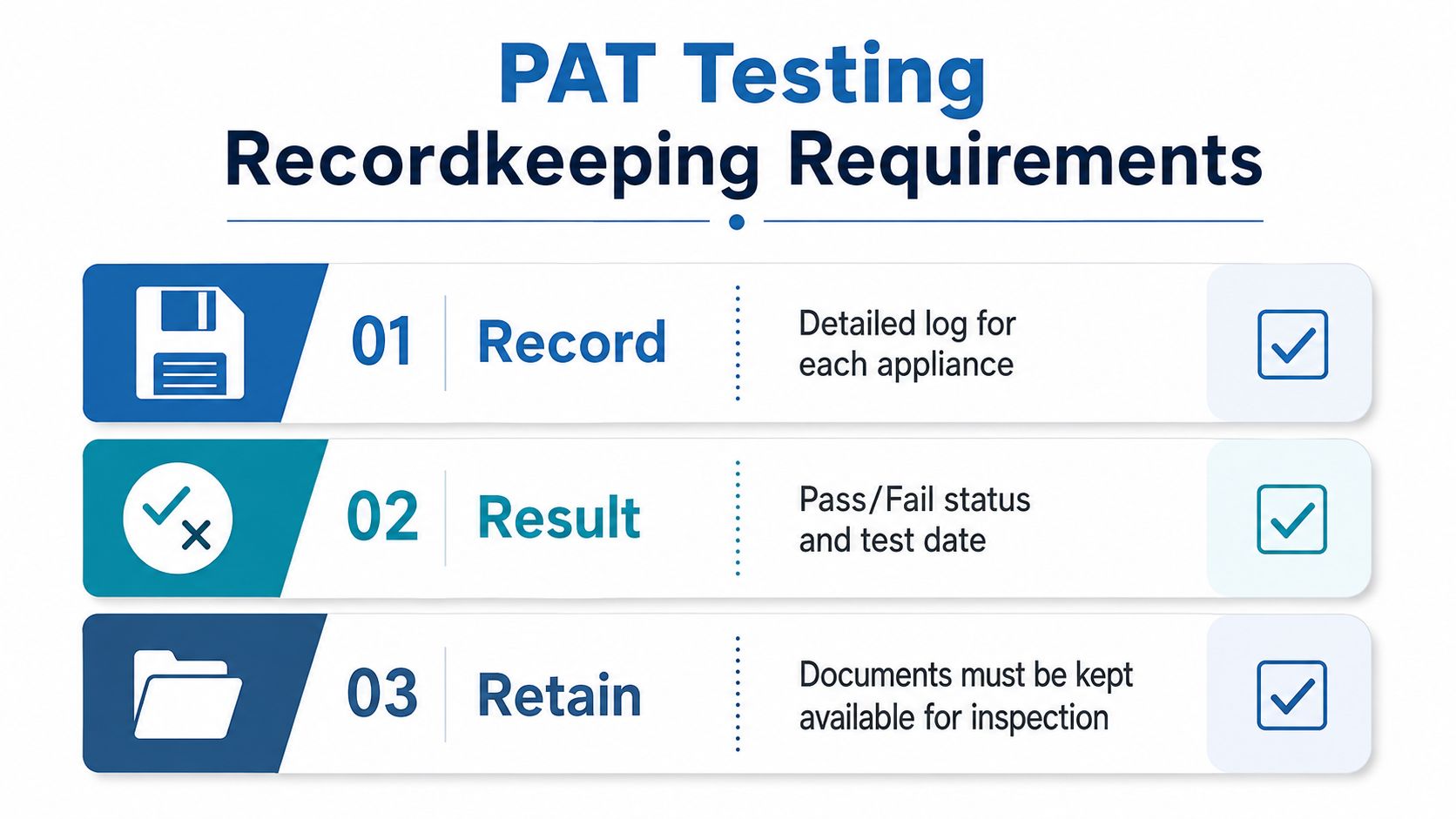
A graphic outlining PAT testing recordkeeping requirements including documenting logs, test results, and maintaining accessible inspection records.

Good PAT records are what let you prove the work was done properly. In practice, that means keeping a clear trail for each appliance, each inspection, and each decision made after a failed result. A graphic outlining PAT testing recordkeeping requirements including documenting logs, test results, and maintaining accessible inspection records.

What the file should show

At a minimum, the record should identify the appliance, note the date it was checked, state the result, and name the person who carried out the work. A certificate or log entry that ties the result to a specific inspection date is far more useful than a loose note saying the item was “checked.”

A failed item needs a clear paper trail too. The log should show that it failed, what happened next, and whether it was taken out of use, repaired, or retested. That matters because equipment that is not safe on the day cannot stay in service on the strength of a shrug and a promise to fix it later.

A good digital system keeps this tidy without much effort. Each appliance should have its own entry, with photos, test results, follow-up notes, and any repair history stored in one place. If a landlord or business owner is managing several sites, separate folders or site tags help prevent confusion between offices, apartments, shops, and storage areas.

How good records help in real life

Clean records do more than satisfy an inspection. They show that the person in charge took reasonable care, and they give you something solid to point to if a dispute arises after a fault or incident.

They also make day-to-day management easier. If you have multiple premises around Dublin, the system should let you see what was tested, what failed, what was repaired, and what still needs attention without digging through loose certificates or old emails.

Digital records are usually easier to search, sort, and back up than paper files, but the format is not the main issue. A messy spreadsheet with missing entries is no better than an untidy folder. What matters is that the trail is complete, readable, and easy to produce when someone asks for proof.

Common Exemptions and Edge Cases

Not every item on a premises needs PAT testing. One of the most useful Irish nuances is that equipment that's rarely moved and protected from damage should not need to be tested unless a risk assessment shows otherwise, according to TU Dublin guidance used in Irish PAT arrangements. That's a useful counterweight to the blanket annual testing myth, and it stops people wasting time on items that aren't really in scope.

What usually falls outside the PAT conversation

Fixed installations are a different issue from portable appliances, so don't mix the two up. A hardwired system, a distribution arrangement, or other fixed electrical work belongs in a different compliance bucket. PAT testing is aimed at portable items, the sort of things you plug in and move around.

New equipment also gets misunderstood. Being new doesn't make an appliance exempt forever, but it can influence the risk picture if the item is low-risk, undamaged, and used in a controlled setting. Battery-powered devices can fall outside normal plug-in PAT thinking, though they still need a sensible safety review where they're being used around staff, tenants, or contractors.

Domestic, landlord, and contractor situations

Homeowners often ask whether every appliance in the house needs to be tested. In a normal domestic setting, that's not how Irish workplace PAT rules operate. Landlords need to think more carefully about what they supply in rental property, while businesses need to look at employee use, visitor use, and contractor equipment separately.

Practical point: if you don't own the appliance, and it's not part of your workplace supply, it usually isn't your PAT responsibility.

That doesn't mean you ignore it. It means you separate ownership, location, and duty of care before you book a test. For example, landlord-supplied items in a rental unit deserve a different approach from a tenant's own charger or laptop. Contractor tools are again different, especially where several firms are on site and temporary electrics are being used.

A proper assessment saves money. You only test what falls within the scope, and you set the interval according to risk instead of habit.

Compliance Checklist and Next Steps

If you want a defensible PAT system in Dublin, keep it simple and organised. Start with a risk assessment, then work outward from there. A sensible programme is easier to maintain than a rushed annual batch of tests no one can explain later.

Compliance checklist graphic for homeowners, landlords, and businesses to ensure regular electrical safety testing requirements.

A practical checklist

  • Identify the appliances: List the portable equipment you control, including landlord-provided items, staff equipment, and site tools.
  • Set the risk level: Look at how often the item is used, where it's used, and whether it gets moved, handled, or exposed to moisture.
  • Choose a competent person: Use someone who understands the equipment class, the risks, and the required documentation.
  • Build the schedule: Match the interval to the risk profile, not to a generic annual rule.
  • Keep the records: Hold onto certificates and test logs for 5 years so you can produce them if needed.
  • Review the plan: Revisit the schedule when the environment changes, new equipment arrives, or an item fails.

If you need a provider, choose a contractor who can explain the rationale behind the schedule, not just the test itself. In Dublin and North County Dublin, that usually means a Safe Electric registered team that understands Irish compliance and issues paperwork you can use. You can also check Forward Electrical's electrical contractors registration page if you're comparing what a registered contractor should be able to provide.

When a business or landlord gets this right, PAT testing stops being a headache. It becomes a routine safety control that fits the property instead of fighting it. If you're unsure what applies to your premises, or you've got mixed equipment across offices, apartments, or worksites, arrange a professional assessment before the next inspection catches you out. For practical help with testing, records, and compliance in Dublin, visit Forward Electrical and talk to a qualified electrician who works with Irish regulations every day.

Irish Electrical Regulations: A Dubliner’s Guide 2026

You're often only looking into Irish electrical regulations when something is already happening. You're buying an older terraced house in Dublin. You're planning a kitchen upgrade. You're getting a rental ready for new tenants. Or an electrician has looked at your fuse board and said, “This really should be brought up to current standard.”

That's usually the point where the questions start. What rules apply. Does an older installation have to be upgraded. What work needs certification. And who's legally allowed to carry it out.

For most homeowners and business owners, “regulations” sounds like paperwork and hassle. In practice, the rules are there for a much better reason. They set the baseline for shock protection, fire safety, proper certification, and accountability if work is done incorrectly.

Irish electrical regulations can feel dense when you first meet them. They're full of references, clauses, standards, and industry language that doesn't mean much if you're attempting to make sense of your own property. The useful part is knowing how those rules affect real jobs in real Dublin buildings.

Table of Contents

Your Guide to Electrical Safety and the Law in Dublin

A common Dublin scenario goes like this. Someone buys a solid older house with plenty of character, then discovers the electrics have had bits added over the years. A new shower circuit here, an outdoor socket there, a few modern light fittings, and an old fuse box still sitting at the heart of it all.

Nothing may seem obviously wrong. Lights work. Sockets work. The immersion comes on. But once renovation plans start, or a survey raises concerns, the question changes from “does it work?” to “is it safe and compliant?”

That's the right question.

Irish electrical regulations aren't there to catch people out. They exist to reduce electric shock risk, limit the chance of electrical fire, and make sure there's a proper trail of responsibility when work is carried out. In Dublin, where housing stock ranges from older red-brick homes to newer apartments and mixed-use commercial units, that matters a lot. No two installations are exactly alike, and older properties especially can hide a lot behind a neat wall finish.

Practical rule: If electrical work changes circuits, protection, or the main distribution equipment, treat it as something that needs proper assessment and certification, not a quick fix.

The sensible approach is to understand three things. First, what the current standard is. Second, which jobs trigger stronger compliance requirements. Third, when a qualified contractor needs to certify the work.

For homeowners, landlords, and business owners, that knowledge makes conversations with electricians much easier. You don't need to know how to wire anything yourself. You do need to know what good, compliant work looks like and where the risks sit if corners are cut.

Understanding the Official Rules for Electrical Work

In practice, the term Irish electrical regulations points mainly to one technical standard for installation work in Ireland. For anyone hiring an electrician in Dublin, that is the document that sets the benchmark for what safe, compliant work should look like.

The rulebook every registered electrician works from

That standard is I.S. 10101:2020, the 5th Edition National Rules for Electrical Installations. It replaced the old 4th Edition, and since 1 April 2022, new electrical installations in Ireland must be designed and certified to the current standard, as outlined by Safe Electric's overview of I.S. 10101.

An infographic titled Irish Electrical Regulations outlining the I.S. 10101 framework, legislation, regulatory bodies, and industry best practices.

In plain terms, this is the rulebook electricians use for the design, installation, inspection, and certification of low-voltage electrical work in Ireland. If a consumer unit is being replaced in a semi-D in Rathfarnham, if new circuits are going into a kitchen extension in Drumcondra, or if a shop unit in the city centre is being refitted, this is the standard the work should be judged against.

That matters because compliant work is not just about getting power back on. It covers circuit protection, cable selection, earthing, testing, labelling, and whether the finished job can be certified properly. In older Dublin properties, that distinction catches people out. A job can appear neat and still fall short if the protection, testing, or documentation is wrong.

For homeowners, landlords, and business owners, the practical takeaway is straightforward. New work should be carried out to the current edition, not to older habits, guesswork, or what someone says was acceptable years ago.

Who does what in the Irish system

Confusion often starts because different organisations handle different parts of the system. Here is the plain-English version:

Body Role in practice
NSAI Publishes the national standard, including I.S. 10101:2020
CRU Sets and oversees the legal framework around electrical safety and regulated works
Safe Electric Registers and audits contractors who can carry out certain controlled work and issue certification

For a property owner, that structure is useful because each part has a clear job. The standard sets the technical rules. The regulator sets the legal framework. Safe Electric registration ties the work to a contractor who can be held to account.

That becomes very real on common jobs. If a fuse board needs replacement, if circuits are being altered during a renovation, or if a landlord is sorting out an unsafe installation after an inspection, the question is not only whether the job can be done. The real question is whether it can be tested, certified, and traced back to the right person if there is ever a problem later.

Good contractors understand that point well. The standard sets the minimum. Proper judgement comes in when the existing wiring is old, access is poor, or the original installation was never designed for the load the building carries now.

Key Safety Upgrades in the Current Regulations

The current rules brought in some very practical safety improvements. These aren't minor wording changes. They affect how domestic installations are protected and how fire risk is managed.

What changed in everyday domestic safety

One of the biggest changes for ordinary homes is lighting circuit protection. I.S. 10101:2020 now requires Residual Current Devices (RCDs) on all lighting circuits in domestic premises, and the CRU and Safe Electric recommend bringing older installations up to this level where reasonably practicable, as explained in this Irish regulations guide from JLK Electrical.

For homeowners, that means the safety standard around lights is no longer where it once was. In older Dublin homes, it's still common to find lighting circuits that don't have this level of protection. The lights may function perfectly well, but the benchmark for safety has moved on.

An infographic titled I.S. 10101: Key Safety Upgrades showing a comparison between pros and cons of electrical regulations.

The standard also recommends Arc Fault Detection Devices (AFDDs) to help reduce electrical fire risk. They aren't part of every domestic job, and whether they're appropriate depends on the property and use case, but they reflect a wider shift in the regulations. Modern compliance is increasingly focused not just on whether a circuit works, but on how well it is protected under fault conditions.

Cable safety has also tightened. Under the current rules, cables in domestic installations must meet a higher fire performance requirement. The baseline referenced for Irish installations is DCA S2-D2, with the broader cable requirement for new installations and full rewires discussed further below.

What this means for older Dublin properties

A lot of owners hear about newer regulations and assume their house instantly becomes illegal. That isn't how it works.

Older installations are not automatically unsafe solely because they were installed to an earlier standard. But they may lack important protections that are now seen as best practice and, in new work, mandatory. That difference matters when you're buying, renovating, extending, or dealing with recurring faults.

Here's the practical view:

  • Older fuse boards may still operate, but often don't offer the level of RCD protection expected today.
  • Lighting circuits in older houses often miss the protection now required in new domestic installations.
  • Older cable types and legacy additions can become a concern when partial upgrades have been done over time without a full review.

A good electrician looks at the installation as a whole. If only one part is upgraded and the rest is left untouched without proper thought, you can end up with an awkward mix of old and new that satisfies nobody. It may technically run, but it won't necessarily be sensible, safe, or easy to certify.

A Compliance Checklist for Common Electrical Jobs

Irish electrical regulations gain practical significance. Individuals don't need to read standards; they need to understand compliance when replacing a fuse board, renovating a kitchen, or adding major new electrical loads.

An infographic checklist for home electrical compliance, highlighting five key safety areas for electrical installations.

Upgrading your consumer unit

This is one of the clearest examples of regulated work. Swapping an old fuse box for a modern consumer unit is classed as notifiable electrical work in Ireland, so it must be carried out and certified by a Registered Electrical Contractor, as explained in this guide to fuse boxes and consumer units.

That matters because a consumer unit isn't just a box on the wall. It's the control point for circuit protection, fault isolation, RCD coverage, and often surge protection.

A compliant upgrade typically involves a professional checking:

  • The status of the existing circuits so faults or unsafe legacy wiring aren't directly connected into a new board.
  • The enclosure type because domestic consumer units should now have a non-combustible enclosure, typically metal, or be housed within a non-combustible cabinet.
  • Certification so the completed work is properly recorded by a contractor who is authorised to sign it off.

If you're trying to understand the condition of an existing installation before this kind of upgrade, an Electrical Installation Condition Report is often the sensible first step.

A short explainer is useful here:

Rewiring a home or carrying out a full renovation

Full rewires and substantial renovation projects now involve stricter cable requirements than many owners expect. The current rules require electrical cables in new installations or full rewires to meet a minimum fire safety class of DCA S2-D2-A2, and the move to compliant cable can increase upfront material cost by approximately 15 to 20 per cent while reducing fire risk, as discussed in this technical video on the cable changes under I.S. 10101.

That's one of the clearest trade-offs in the current standard. The materials can cost more. The upside is a better level of fire performance and compliance with the newer safety baseline.

When a contractor prices a rewire properly, they should be considering:

Project point What a professional needs to consider
Cable specification Whether the installation requires compliant fire-rated cable throughout
Circuit design Whether the property layout and load profile suit a full redesign rather than patching old circuits
Protection devices Whether the installation needs updated RCD arrangements and other modern protections
Testing and certification Whether the entire installation can be verified and certified as completed work

The jobs that cause trouble are usually the halfway jobs. New kitchen, old board. Extension, but no review of the existing system. Attic conversion, but borrowed supply taken from a circuit that was already stretched. Those are the situations where compliance can become messy.

Surge protection and the grey area homeowners ask about

Surge Protection Devices, or SPDs, cause more confusion than they should. A lot of homeowners assume they're optional in every domestic setting. That's not really the right way to look at it.

Under I.S. 10101, there's a default expectation that a risk assessment is needed to justify omitting surge protection in many cases, and homeowners often misunderstand when their property does or doesn't qualify, as outlined in this summary of I.S. 10101 surge protection changes.

If a contractor shrugs off surge protection without discussing the installation, the use of the building, and the basis for omitting it, that's not a great sign.

For a homeowner, the practical question isn't “Do I personally like the idea of SPDs?” It's “What does the installation require, and what is the basis for leaving them out if they're not being fitted?”

EV chargers and other high demand additions

Some jobs aren't described by homeowners as “major electrical work,” but they absolutely change the demands on the system. EV chargers are the obvious example. So are heat pumps, electric showers, induction hobs, and larger home office loads.

The right approach is for a qualified electrician to assess whether the existing board, circuit protection, and overall installation are suitable for the added demand. In many homes, this isn't a problem if the installation is modern and well designed. In older homes, adding one large load can expose weaknesses that were already there.

For this type of work, the best question to ask is not “Can it be connected?” but “Can it be connected safely, compliantly, and certified properly?”

Who Is Responsible for Electrical Safety

Responsibility sits in different places depending on the property and how it's used. The rules don't land the same way for an owner-occupier, a landlord, and a business operator.

A bright, modern open-plan living and dining room with wooden furniture and a clear view of the garden.

Homeowners

For homeowners, the main responsibility is due diligence. If you're buying, renovating, extending, or dealing with repeated electrical issues, you need to know what condition the installation is in before more money is spent on finishes and fittings.

A common blind spot is assuming that because a house has power, the system must be up to modern expectations. That's often not true in older Dublin housing stock. If a property has had piecemeal work done over the years, a proper inspection matters far more than appearances.

Where full rewires or new installations are involved, cable specification now matters too. I.S. 10101:2020 requires electrical cables in new installations or full rewires to meet a minimum fire safety class of DCA S2-D2-A2, and this can increase upfront material costs by approximately 15 to 20 per cent while reducing fire risk, as covered in the earlier technical reference on cable standards.

Landlords

Landlords carry a clearer safety burden because somebody else is living with the installation every day. In practice, that means not waiting for tenants to report obvious faults before taking action.

The difficult cases are usually older rental properties with dated boards, limited circuit protection, and previous quick fixes. A landlord doesn't need to rebuild a sound installation for the sake of it, but they do need to take a sensible view of risk, especially when the property lacks protections now considered important in domestic settings.

Useful habits for landlords include:

  • Assessing before reletting rather than assuming the last tenancy tells the whole story.
  • Keeping certification records for significant electrical work.
  • Acting on advisory findings where protective devices or wiring condition raise safety concerns.

Business owners

For businesses, electrical safety isn't only about the fixed wiring. It's tied to staff safety, continuity of operations, emergency systems, and the wider duty to keep the premises safe.

A small office, café, retail unit, or salon may not think of itself as a high-risk environment. But if electrical faults interrupt trading, affect emergency lighting, or create fire hazards, the impact is immediate. Commercial premises also tend to accumulate changes quickly. Extra equipment, altered layouts, temporary additions that become permanent, and signage or display lighting all add complexity.

On commercial sites: The installation should match the way the business actually operates now, not the way the unit was first fitted out years ago.

For owners and managers, the practical responsibility is to make sure electrical work is assessed professionally, changes are documented, and compliance isn't treated as a one-off event after the keys are handed over.

Why You Must Use a Safe Electric Registered Contractor

A person can call themselves an electrician. That doesn't mean they're authorised to carry out every category of electrical work in Ireland or issue the certification you may need afterwards.

Certification matters as much as the installation

For regulated electrical work, using a Safe Electric registered contractor isn't just about workmanship. It's about legal compliance, certification, and traceability. The installation has to be safe, but it also has to be capable of being properly signed off within the Irish system.

That becomes especially important when the work affects core parts of the installation, such as consumer units, new circuits, or other restricted works. If the person doing the job can't issue the right certification, you may be left with work that physically exists but creates a problem on paper and potentially during sale, letting, inspection, or further alterations.

If you want a plain-English breakdown of what registration means, this guide to a registered electrical contractor is worth reading.

What goes wrong when the wrong person does the job

The trouble with unregistered work is that it often looks fine at a glance. The socket works. The lights come on. The board looks tidy.

The issues usually appear later:

  • No valid certification when documentation is requested
  • Unsafe legacy faults left in place because the wider installation wasn't assessed properly
  • Problems when selling or renovating because new contractors won't stand over undocumented work
  • No meaningful accountability if defects appear after the job

A good registered contractor doesn't just install. They inspect, test, certify, and take responsibility for the finished result. That's the standard people should be paying for.

Making Sense of Electrical Safety in Your Property

Becoming an expert in Irish electrical regulations is not always necessary; a clear understanding of the fundamentals is sufficient. The current national standard matters. Certification matters. And the person carrying out the work matters just as much as the materials being installed.

That's true whether you're looking at an older fuse board, planning a renovation, checking a rental, or trying to decide if a full rewire is the right move. If the installation is being changed, the right question is always whether the work is safe, compliant, and properly certifiable.

If you're unsure about the condition of your wiring, or you're weighing up a larger upgrade, it helps to understand what's involved in a house rewiring project in Dublin before any decisions are made.


If you'd like straightforward advice on your property's electrics, Forward Electrical provides domestic and commercial electrical services throughout Dublin. If something doesn't look right, or you want clarity before starting work, it's worth arranging a professional inspection and getting proper guidance before small issues turn into bigger ones.