What Is PAT Testing? a 2026 Guide for Dublin

PAT testing, or Portable Appliance Testing, is the process of inspecting and testing movable electrical equipment to confirm it's safe to use. In Ireland, it sits within the Safety, Health and Welfare at Work framework and follows a risk-based approach, rather than a fixed annual rule for every appliance.

That first point matters because “annual PAT testing” is often presented as if it were a universal legal requirement. It isn't. The practical duty for a Dublin landlord or business owner is to manage electrical risk properly, use a competent person where inspection and testing are required, and keep evidence that the equipment was assessed and safe on the day.

A desktop computer in a quiet office, a heater in a busy café, and a handheld power tool on a building site don't experience the same wear. Treating them as if they do may create unnecessary work in some areas while missing genuine risks in others.

Table of Contents

What PAT Testing Means in Ireland

PAT testing is a safety process, not a sticker on an appliance. It covers the inspection of portable or movable electrical equipment, including appliances, leads and plugs. Appropriate electrical tests are then carried out where the risk assessment and the equipment call for them.

The legal context sits within Ireland's workplace safety framework. The Health and Safety Authority guidance on inspection and testing explains that an existing electrical installation must be tested by a competent person. Irish guidance used by public bodies also states that portable equipment supplied at voltages above 125 volts AC should be inspected and, where appropriate, tested by a competent person. A certificate should confirm that the equipment was safe on the day of inspection.

PAT testing therefore forms part of a documented workplace safety system. It helps a landlord or business owner show that movable equipment has been considered where damage, deterioration, frequent movement or misuse could create a hazard.

An infographic clarifying that annual PAT testing is not a legal requirement for businesses in Ireland.

The legal framework and competent person

Irish PAT expectations are rooted in the Safety, Health and Welfare at Work (General Application) Regulations 2007. The regulations require portable electrical equipment to be managed safely, but they do not set one testing date for every appliance in every premises.

A competent person has the training, knowledge and practical ability to identify electrical hazards, understand the equipment being assessed, use suitable testing equipment and interpret the results correctly. Owning a PAT tester does not, by itself, establish competence.

Practical rule: A pass label provides useful evidence, but it does not replace assessment of how equipment is used, maintained and exposed to damage.

For a Dublin office, rental property, retail unit or hospitality venue, the useful question is whether risks have been identified, suitable inspections completed and records kept. A blanket annual programme may suit some equipment, while other items may need a different inspection approach based on their use and condition.

What Happens During a PAT Inspection

A professional PAT inspection normally starts before any electrical test is carried out. The competent person considers the premises, the type of equipment, how often it's moved, and the conditions in which it operates.

The visual check is often where obvious problems are found. The appliance body, flex and plug top are examined for damage, overheating, loose parts, contamination or signs of misuse. A cable that has been crushed behind furniture, a plug showing heat damage, or a casing cracked after being dropped may need attention before any test result is considered.

The electrical test then depends on the appliance's construction. Class 1 appliances require an earth continuity test because their protective safety depends on an earth connection. Class 1 and Class 2 appliances can also require insulation resistance testing, with the exact approach selected by the person carrying out the inspection.

An infographic illustrating the five-step process of a PAT inspection, from initial risk assessment to final documentation.

What the property owner receives

The process should leave a clear trail rather than a collection of unexplained stickers. A tested item will usually receive a label showing its pass or fail status, test date, re-test date and appliance identification. Irish institutional guidance also requires tested items to be labelled with the date and tester initials.

The professional will record failed equipment and advise that it's withdrawn from use where it presents a danger. A failed appliance shouldn't remain available just because it's inconvenient to remove, particularly in a workplace where staff, tenants or customers could use it.

For a broader explanation of the inspection and testing process, see Forward Electrical's PAT testing guide.

How Testing Frequency Is Decided

Irish guidance doesn't set one universal fixed interval for every portable appliance. The appropriate frequency depends on the equipment, how it's used, how often it's moved, and the environment around it, as outlined in the HSA guidance on periodic inspection and testing.

A handheld tool on a construction site faces repeated movement, impact and cable flexing. A heater in a hospitality kitchen may encounter moisture, heat, grease and frequent handling. A desktop computer in a low-risk office is usually exposed to a different pattern of wear. Those differences should influence the inspection plan.

Irish institutional guidance gives useful examples of how this works. New equipment usually doesn't need formal PAT if it's in safe condition, although a visual check remains sensible. Rarely moved equipment in a safe environment may not need formal testing unless the risk assessment identifies a reason.

A practical comparison

The intervals below are typical planning examples, not universal legal deadlines. A competent person should confirm the schedule for the actual premises.

Environment Equipment examples Typical interval
Low-risk office Desktop computers and office equipment Often annual checks
Domestic or low-use premises Rarely moved appliances in safe conditions Based on risk assessment
Hospitality setting Kitchen heaters and frequently handled appliances Often six to twelve months, or more frequently where conditions demand it
Construction-type environment Handheld tools and heavily moved equipment Often six to twelve months, or more frequently where exposure is severe

The Irish PAT requirements guidance is useful for owners creating a schedule, but the schedule shouldn't become a substitute for judgement. A calendar reminder can support compliance. It can't identify a damaged lead that appears between planned visits.

Understanding Class 1 and Class 2 Appliances

The appliance class tells the tester how the equipment is designed to protect the user. It also determines which electrical checks are relevant.

Class 1 equipment relies on an earth connection for safety. Many appliances with exposed metal parts fall into this category. If the protective earth path is damaged or missing, a fault could make the accessible metalwork dangerous.

Class 2 equipment uses double or reinforced insulation and doesn't require an earth bond. It's identified by the double-square symbol on the rating plate. The absence of an earth connection doesn't mean the appliance is unimportant. It means its protection is provided through insulation rather than an earth path.

Appliance class Safety method Relevant PAT consideration
Class 1 Earth connection Earth continuity testing is important
Class 2 Double or reinforced insulation Insulation resistance testing is used, with no earth bond required

An educational infographic explaining the differences between Class 1 and Class 2 electrical appliances for safety.

In practical premises, kettles, extension leads and many power tools may be treated as Class 1 or Class 2 depending on their design, so assumptions aren't reliable. Phone chargers and desk lamps may use double insulation, but the tester should confirm the classification from the appliance and its markings rather than guessing from appearance.

This distinction matters because a competent person chooses the appropriate test for each item. It also helps explain why a mixed-use building shouldn't automatically receive one identical testing approach for every appliance.

Documentation and Record Keeping Requirements

A PAT programme is defensible when another person can see what was inspected, when it was inspected, who completed the work and how failed equipment was handled. An appliance label supports that record, but it cannot replace it.

Irish institutional guidance requires each tested item to show the inspection date and tester's initials. TU Dublin guidance says inspection results should be retained for the lifetime of the equipment. Other Irish PAT guidance requires results to be recorded and kept available for 5 years from the inspection date. Requirements can vary by organisation and workplace, so set a written retention policy that meets the relevant client and workplace expectations. Where practical, lifetime retention gives stronger traceability.

A checklist infographic outlining documentation and record-keeping requirements for Portable Appliance Testing, emphasizing the need for traceable records.

What a useful record contains

A useful register connects every appliance to its inspection result. It should identify the equipment, record inspection and testing dates, show a pass or fail outcome and name the person who carried out the work.

For a Dublin landlord or facilities manager, include:

  • Asset identification: Give each item a clear ID that matches the label on the appliance.
  • Inspection result: Record the outcome and any action taken.
  • Tester details: Keep the tester's name and evidence of competence with the report.
  • Location: Note the room, unit or tenant area where the appliance was found.
  • Follow-up action: Record whether failed equipment was repaired, removed, replaced or returned to service after suitable assessment.

The HSA's electrical inspection guidance emphasises competence, certification and accessible records. That matters in mixed-use premises, where office equipment, kitchen appliances, heaters and extension leads can require different inspection schedules.

A spreadsheet is suitable for a small property if someone keeps it current. Larger offices, retail groups and multi-tenant buildings may need an asset-management system to track equipment as it moves, gets replaced or is disposed of. A missing record can make a completed inspection difficult to prove.

Common PAT Testing Misconceptions Among Property Owners

A landlord once asked whether every appliance in a rental property had to be PAT tested every year. That approach may sound cautious, but it can be poorly targeted if nobody has considered which items are portable, how they're used, or whether the equipment has changed since the last inspection.

The first misconception is that annual testing is a blanket legal requirement. Irish guidance supports a risk-based, competence-driven approach, not one identical annual rule for every appliance. An annual schedule may be sensible for some offices, but it shouldn't be treated as the legal answer for a construction environment, a kitchen or a rarely used item.

New appliances and fixed installations

New equipment is another source of confusion. Irish university guidance says new equipment usually doesn't need formal PAT if it's in safe condition, although a visual check should still take place. A café owner who assumes “new” means “no checks at all” may overlook damaged packaging, a faulty lead or an installation problem, while a landlord who formally tests every new item without considering risk may spend effort where a documented visual check would be appropriate.

PAT testing also isn't the same as inspecting a fixed electrical installation. PAT focuses on movable equipment such as appliances, leads and plugs. An inspection of fixed wiring, distribution equipment and permanent circuits addresses a different part of the electrical system.

Finally, competence shouldn't be confused with job title. A person may be an electrician, maintenance worker or facilities employee, but the relevant question is whether they're competent to assess portable equipment, use the testing device correctly and interpret the results. Irish guidance consistently places the emphasis on competence rather than a label alone.

How Forward Electrical Delivers Compliant PAT Services

A sound PAT service begins with the premises, not the tester. Forward Electrical can review the equipment in context, separating items by location, use, movement and exposure to damage before a suitable schedule is prepared.

For a Dublin terraced rental property, that may mean a focused assessment of movable appliances provided with the tenancy. A hospitality venue may need closer attention to kitchen equipment, heaters, leads and appliances exposed to demanding conditions. A multi-tenant office block may need an asset register that makes responsibility and location clear across shared areas and individual suites.

The inspection itself combines visual assessment with appropriate electrical testing by a competent person. Equipment is identified, results are recorded, failed items are highlighted for withdrawal or further action, and labels provide a visible link between the appliance and the report. That process is more useful than applying the same date to every item without considering its actual condition.

Forward Electrical's team is presented as a Safe Electric registered electrical contractor, and clients should always confirm the qualifications, registration and competence relevant to the work being arranged. After testing, the important deliverable isn't only a pass label. It's a usable evidence trail that supports ongoing maintenance and shows what was assessed.


Forward Electrical provides professional PAT testing and wider electrical services for landlords, offices, retail premises and hospitality businesses throughout Dublin. Visit Forward Electrical to discuss your equipment, build a risk-based testing schedule and arrange clear records for your premises.

PAT Testing Dublin: A Practical Guide for 2026

You're a Dublin landlord handing over keys, a café owner getting ready for an inspection, or an office manager dealing with a faulty charger. Suddenly, someone asks for PAT records, and a simple question follows: what needs testing, how often should it happen, and what paperwork should you keep?

The honest answer is more practical than a blanket annual rule. PAT testing in Dublin is a risk-based part of workplace electrical safety, shaped by the equipment, its environment and how heavily it's used. The right programme protects people and gives you organised evidence that unsafe items have been identified and dealt with.

Table of Contents

Why PAT Testing Matters in Dublin Properties

A landlord in a Dublin terrace may only think about portable appliances when a tenancy changes. A café owner might start looking for records before an insurance inspection, while an office manager may take action after a kettle trips a socket or a laptop charger shows a damaged lead. These situations are common reasons PAT testing moves from the bottom of a maintenance list to the top.

The concern isn't the certificate by itself. It's whether equipment used by tenants, staff or customers remains safe in the conditions where it operates. A charger sitting on a desk in a quiet office has a different exposure to wear than an extension lead dragged across a busy hospitality floor or a power tool used on a fit-out.

Practical rule: PAT testing works best as an organised maintenance habit, not as a last-minute search for paperwork.

Irish workplace safety duties sit within a wider legal framework, rather than a standalone voluntary scheme. You can read more about the Irish electrical regulations affecting workplace safety if you're trying to understand how portable equipment fits alongside other electrical responsibilities.

The risk is often ordinary wear

Many defects are visible before a meter is connected. Frayed cables, loose plug tops, scorch marks, cracked housings and strained connections can develop through everyday handling. A professional inspection gives those defects a defined route: record the item, assess it, remove it from service where necessary, and arrange repair or replacement.

That matters across Dublin property types. Tenants depend on safe appliances, employees use office equipment for long periods, and customers may come into contact with equipment in cafés, salons, shops and venues. A clear register also helps a property manager see which items were checked, which failed, and what still needs attention.

PAT testing doesn't replace sensible visual checks or proper maintenance. It gives the business or property owner a repeatable way to manage portable equipment and demonstrate that electrical safety is being taken seriously.

What PAT Testing Actually Covers

Portable appliance testing is a professional inspection and testing process for electrical equipment that can be moved, or that is connected to an installation by a flexible cable. In a Dublin workplace, that can include kettles, monitors, laptop chargers, extension leads, printers, vacuum cleaners, power tools and portable kitchen equipment.

The word “portable” doesn't only mean something small enough to carry under one arm. A treadmill in a gym, for example, may stay in the same position for long periods but still connect through a flexible lead and remain exposed to movement, impact or cleaning activity. A competent person considers how the item is supplied, used and exposed to deterioration.

An infographic detailing the three-step PAT testing process for electrical safety compliance in Ireland.

Visual inspection comes first

A qualified tester normally begins with the condition of the appliance, cable and plug. That examination can identify:

  • Damaged leads: Cuts, exposed conductors, crushing or heat damage can make an item unsafe.
  • Plug problems: Loose connections, damaged plug tops or missing parts need attention before use.
  • Signs of overheating: Scorching, discolouration or a burnt smell may indicate a developing fault.
  • Mechanical damage: Cracked cases, loose covers and damaged strain relief can expose users to danger.

Electrical testing follows where appropriate. Irish PAT guidance identifies checks such as earth continuity, insulation resistance, protective conductor current, touch current and earth leakage, depending on the appliance and the risks involved. These tests help a competent person assess whether protective arrangements and insulation remain suitable.

PAT testing isn't a fixed-wiring inspection

A PAT visit focuses on portable equipment. It isn't the same as a periodic inspection of the fixed installation, and a PAT certificate doesn't confirm that the distribution board, sockets, lighting circuits or concealed wiring are in good condition.

The HSA's electricity guidance lists installation tests including continuity, resistance or conductance, polarity, fault loop impedance and RCD operation in the context of post-installation testing. That's a different scope from portable appliance testing, so a business may need both forms of assessment.

The useful question is not whether every appliance has a sticker. It's whether the equipment has been identified, inspected, tested where suitable, and managed according to its actual working environment.

The Irish Legal Framework for PAT Testing

Irish law requires inspection and testing when electrical equipment is exposed to conditions likely to cause deterioration. The main framework is the Safety, Health and Welfare at Work Act 2005 and the Safety, Health and Welfare at Work (General Application) Regulations 2007, specifically S.I. No. 299 of 2007. These regulations took effect in November 2007 and set workplace duties relevant to portable equipment. The Irish PAT testing requirements should therefore be read alongside the wider employer safety obligations.

The duty generally rests with the employer when equipment is supplied for use at work. The employer must arrange periodic inspection and testing by a competent person where the working conditions could cause deterioration. The rules apply specifically to portable equipment supplied above 125 volts AC. Any inspection or test certificate should identify the item and cover its cables and plug tops, so far as could reasonably be established on the inspection day. The Irish PAT testing guidance on equipment and inspection duties explains these requirements in practical terms.

A flowchart explaining the Irish legal framework for portable appliance testing in the workplace.

The legal trigger is exposure to deterioration

A controlled Dublin office, a busy café, a rented apartment under active management and a construction site present different conditions for electrical equipment. Moisture, heat, dust, vibration, movement, impact, frequent handling and cleaning can all affect the inspection approach. The property type matters because it helps establish how equipment is used, who handles it and what records the employer needs.

Irish law does not set one fixed interval for every appliance. “Periodically” requires a suitable inspection and testing arrangement based on risk, equipment type and use history. An annual visit may be sensible for some workplaces, while another setting may call for a different frequency. The competent person and responsible manager should be able to explain the choice rather than rely on a sticker date alone.

A written risk assessment should record:

  • The equipment: construction, electrical class, age and previous defects.
  • The environment: heat, moisture, dust, movement, impact and cleaning routines.
  • The users: staff, contractors, tenants, students or members of the public.
  • The history: earlier failures, repairs, repeated faults and changes in use.

That record gives a Dublin business a clear basis for scheduling inspections, retaining certificates and showing why its maintenance arrangements match the conditions on site.

Who Needs PAT Testing in Dublin

The need for PAT testing is easiest to understand by looking at the premises and the people using the equipment. A private landlord, office manager and construction contractor may all manage portable appliances, but their exposure to wear and the records they need can differ substantially.

An infographic highlighting the necessity of PAT testing for landlords, offices, retailers, and construction sites in Dublin.

Landlords and residential properties

A landlord renting a Dublin apartment or house should separate two questions. First, is the equipment being supplied for use in a workplace? Secondly, what appliances are being provided to tenants, and what condition are they in?

Domestic landlord duties can depend on the circumstances, so a PAT label shouldn't be treated as a substitute for broader electrical safety checks. Where a landlord supplies appliances as part of a managed rental property, keeping an inventory and records of condition is sensible, particularly for older kettles, washing machines, heaters, chargers and extension leads.

Offices and coworking spaces

Office equipment often includes monitors, desktop computers, laptop chargers, printers, desk lamps, kettles and extension blocks. The environment may be relatively controlled, but shared equipment changes hands frequently and cables can be moved, trapped or damaged under desks.

Some Dublin-sector guidance commonly uses 48 months for certain class 1 stationary or IT equipment, while other moveable items may be managed at 24-month intervals, depending on risk and the equipment category. These examples come from Irish PAT testing interval guidance, not from a universal statutory timetable.

Retail, hospitality and construction

Retail units and cafés combine staff use with public access, frequent cleaning and busy working areas. Kitchens can expose appliances to heat, moisture, grease and impact, so the risk assessment should reflect those conditions rather than copy an office schedule.

Construction and fit-out sites are more demanding again. Tools, extension leads and portable equipment may be moved between areas, exposed to dust and knocks, and connected in changing conditions. Records should identify each item clearly, show its result and make it easy for supervisors to remove failed equipment from service.

What Happens During a PAT Test Visit

A professional PAT visit usually begins with an agreed scope. The tester and site contact identify the rooms, storage areas, shared appliances and equipment that contractors or staff bring into the premises. Good preparation means appliances are accessible, but staff don't need to dismantle anything or carry out electrical work.

The tester then creates or updates an asset register. Each item receives an identifiable record, often including its description, location, asset reference and test outcome. A record that lets someone find the exact appliance later is more useful than “kettle in the kitchen”.

The inspection and testing sequence

The process normally follows a logical order:

  1. Visual assessment: The tester checks the appliance, cable, plug, casing and visible signs of damage or overheating.
  2. Instrument testing: Where appropriate, test equipment checks electrical safety characteristics relevant to the item.
  3. Result recording: The tester records whether the item passes, fails or needs further action.
  4. Identification: Suitable labels or other markings link the physical appliance to its test record.
  5. Documentation: The customer receives the agreed certificate, report or asset register.

Some appliances may need to be unplugged briefly. A tester can often work room by room so staff can continue with minimal disruption, but a busy kitchen, retail floor or workshop may need a quieter appointment time. The sensible arrangement depends on access, the number of items and whether equipment is essential to daily operations.

A failed item shouldn't receive a new label after a quick reset. It should be clearly identified, removed from service where necessary, and assessed for repair or replacement by a qualified person. Re-certification should follow only after the defect has been properly addressed.

What Drives PAT Testing Cost in Dublin

The cost of a PAT job depends on the work involved, not just the number printed on a quote. A small office with accessible equipment is a different assignment from a café where appliances are distributed through a working kitchen, or a construction site where tools and leads require careful identification.

The main factors include the following:

Cost Driver Why It Matters Typical Effect on a Quote
Number of items More appliances require more inspection, testing and records. More labour and documentation.
Appliance mix Different classes and designs may require different checks. Greater testing complexity.
Access Items hidden under desks, behind counters or in storage take longer to locate. Longer attendance time.
Working environment Kitchens, workshops and construction areas can require more careful handling. Increased time and planning.
Scheduling Out-of-hours visits may be needed to avoid interrupting trading or staff work. Additional scheduling complexity.
Reporting format Asset registers, certificates and itemised reports require organised data. More administration where detailed records are requested.

The cheapest quote may not be the most useful if it provides only a sticker and no clear register. Ask whether the service includes visual inspection, appropriate electrical tests, defect identification, an itemised report and a format your manager can maintain.

Bundling PAT testing with planned electrical maintenance can improve efficiency where the same contractor is already attending the property. Splitting work across different visits may suit a large operation, but only if the records clearly show what has been tested and what remains outstanding.

Certification, Records and Choosing a Contractor

Paperwork is part of the safety system. Under the 2007 General Application Regulations, records of inspections and tests must be kept available for at least 5 years, as set out in Irish PAT testing regulatory guidance. University guidance in Dublin also states that PAT inspection results should be recorded and retained for the lifetime of the equipment, and made available for inspection by the Health and Safety Authority.

That longer approach is practical. If an appliance remains in service, its history can show repeated checks, earlier defects, repairs and changes in location. A current pass label tells you what happened on the inspection day. A properly maintained asset register tells you how the item has been managed over time.

An infographic outlining the essential requirements for record-keeping and selecting a qualified contractor for electrical safety testing.

What to ask before booking

A suitable contractor should be able to explain:

  • Who will attend: Check qualifications, relevant experience and whether the person is competent for the equipment and environment.
  • What the report includes: Ask for an itemised register, test results, failed-item details and any recommended action.
  • How defects are handled: Confirm that unsafe equipment is identified clearly and not left in normal use.
  • What registration applies: For wider electrical work, check whether the contractor is a Safe Electric registered contractor and whether the team has suitable RECI qualifications.
  • What insurance is held: Request confirmation that appropriate public liability and professional cover are in place for the work being undertaken.

Forward Electrical provides PAT testing for commercial and domestic properties as part of its Dublin electrical services, alongside broader inspection and maintenance work. A contractor's usefulness is measured by the clarity of the records left behind, not merely by how quickly labels are applied.

Common Questions About PAT Testing in Dublin

Does a domestic landlord always need PAT testing?

Not every domestic rental situation follows the same workplace rule. A landlord should consider the appliances supplied, the tenancy arrangement and the risks presented, then obtain qualified advice rather than assuming that a PAT label alone settles every electrical responsibility.

Does PAT testing replace a wiring inspection?

No. PAT testing concerns portable equipment. Fixed wiring, sockets, protective devices and the wider installation require their own inspection and testing where appropriate.

What happens when an appliance fails?

The item should be identified clearly and removed from service where it presents a safety risk. A qualified person can then assess whether repair is suitable or whether replacement is the safer option. The register should record the outcome.

How often should records be reviewed?

Review them whenever equipment changes, a fault occurs, the environment changes or an earlier inspection identifies repeated problems. The inspection interval should reflect risk, not an automatic annual assumption.

If you're responsible for a Dublin home, rental property, office, shop, café or worksite, Forward Electrical can advise on the portable equipment in scope, organise professional PAT testing and provide clear records for ongoing maintenance. Visit Forward Electrical to request advice or arrange a suitable booking.

PAT Testing Requirements Ireland: A Practical Guide

Most advice on pat testing requirements Ireland gets one big thing wrong, it talks as if every portable appliance must be tested every year. That's not how the Irish system works. The actual rule is risk-based, so the right interval depends on the equipment, where it's used, how hard it's used, and its history, not a blanket calendar date.

For a landlord, business owner, or property manager in Dublin, that difference matters. It changes what you need to plan, what you need to document, and what you need to challenge when someone tries to sell you a one-size-fits-all schedule. It also explains why PAT testing is part compliance, part recordkeeping, and part sensible maintenance.

Table of Contents

The Truth About PAT Testing in Ireland

The first thing to get straight is this, Irish law doesn't create a universal annual PAT rule. The legal framework points you towards periodic inspection and testing by a competent person, then leaves the interval to risk assessment and the conditions on site.

That matters because a tidy office printer and a kettle in a busy staff kitchen do not carry the same risk. The law reflects that reality. A low-risk item that sits still in a clean environment can justify a very different schedule from hand tools, heaters, or equipment used in damp, crowded, or high-wear settings.

What that means in practice

If you're a landlord or business owner, PAT testing should not be treated as a tick-box job you do once and forget. It is an ongoing control, and the interval should make sense for the appliance and the environment. Irish guidance on Irish electrical regulations and compliance reflects the same principle, with office equipment often taking a much longer interval than equipment used by the public or on construction sites.

Practical rule: if you cannot explain why an appliance is on that testing cycle, you probably do not have a defensible cycle yet.

That is the difference between over-testing and proper compliance. Over-testing wastes time and money on low-risk items. Under-testing leaves gaps where faults can sit unnoticed until someone finds them the hard way. For employers, the point is not just to pass a test, it is to be able to show a sensible system when the HSA asks questions.

If you have only ever heard “annual PAT testing”, keep reading, because that shortcut can lead to poor decisions in both directions. The better question is whether your current setup can be justified on risk, usage, and records.

Legal Framework and Regulatory Requirements

Irish PAT obligations come from the Safety, Health and Welfare at Work Act 2005 and the Safety, Health and Welfare at Work (General Application) Regulations 2007, S.I. No. 299, which came into force in November 2007. The practical duty sits with employers and other duty holders, who must make sure portable equipment used in the workplace is periodically inspected and tested by a competent person. That framework is set out in the legislation summary at PATCert, and the wider compliance context is covered in Forward Electrical's Irish electrical regulations page.

The key point is that the regulations focus on workplace safety, not on one universal interval that suits every appliance. Compliance is not just booking a test and archiving the invoice. It means assessing risk, setting a sensible inspection cycle, and showing that unsafe equipment is taken out of use until it is made safe and recertified.

What employers have to do

The Irish regime creates a clear chain of responsibility. The employer identifies the equipment, the competent person inspects and tests it, and the records show what was checked and when. Where a certificate shows the equipment was not safe on the day of inspection, it has to be removed from use until it is made safe and recertified.

That is why PAT testing works as a governance tool as much as a safety check. It gives you evidence during an HSA inspection. It also gives you a defensible trail if a tenant, employee, insurer, or contractor asks what was done and when.

The document trail matters

Irish rules require inspection and test records to be kept for 5 years. That retention period turns PAT from a one-off maintenance job into an audit-ready control system, because you need to show continuity, not just a current certificate. In practice, you should be able to find the appliance, the result, the date, and the person who carried it out.

If the records are messy, the testing programme usually is too.

That is the standard I would use on a real job in Dublin. The law sets the framework. Good records show you have applied it.

What Adequate Inspection and Testing Involves

A proper PAT visit starts with a visual inspection, because many faults show up before any meter is used. The person doing the work needs to understand electrical, mechanical, and thermal damage, know the appliance class, and have enough experience to judge whether the item is still safe to keep in service, according to PAT Testers' guidance on who can carry out PAT testing.

An infographic illustrating the three steps of PAT testing: visual inspection, electrical testing, and using a competent person.

For portable equipment supplied at a voltage exceeding 125 volts AC, the same source says it should be inspected and, where appropriate, tested, with a certificate confirming that the equipment, including cables and plug-tops, was safe on the day of inspection as far as could reasonably be ascertained. That wording matters in real paperwork. It shows the condition at the time of testing, not a vague “all good” note that will not help you if an HSA inspector, insurer, or tenant asks for proof.

What a competent person looks for

A competent person is not just someone holding a tester. They need enough background to spot damage, interpret the results, and understand what matters for the appliance class. Irish guidance from DWSFS sets out the practical split between checks, with Class I items generally requiring earth continuity and insulation resistance checks, while Class II items focus on insulation integrity because they do not have a protective earth.

That distinction affects the job on site. A kettle, a desk lamp, and a double-insulated charger do not get treated the same way, even if they sit in the same office, rental property, or workshop. For a plain-English breakdown of the process, Forward Electrical's explanation of PAT testing is a useful reference point.

What you should expect to receive

A decent testing visit should leave you with more than a sticker on a plug. You should get a certificate or report that identifies the appliance, the date, the result, and the person who tested it. You should also expect any failed item to be clearly marked and removed from use until it is fixed and re-tested.

That paperwork is the point of the exercise. For businesses, it is the record that supports your position in an inspection or dispute. For landlords, it shows you took reasonable steps. For managers, it becomes the basis for the next testing cycle and helps keep the programme tidy enough to stand up to scrutiny.

Risk-Based Testing Frequencies by Equipment and Environment

Ireland does not use one fixed statutory interval for every appliance, and that is where a lot of people get caught out. The HSA approach is risk-based, so the right interval depends on the equipment, the environment, how often it is used, and its past condition. The practical guidance in circulation, including construction-focused advice from DLS Safety, shows that spread clearly.

Typical intervals by context

Equipment Type Environment Recommended Interval
Office equipment Low-risk office setting 2 to 5 years
Equipment used by the public Public-facing environment 12 months
Portable tools and equipment Active construction site Every 3 months

The table is a guide, not a substitute for judgment on the ground. A low-risk office workstation can justify a longer cycle, while a public-facing appliance or a site tool needs tighter attention because it sees more handling, more wear, and more exposure.

Why the environment changes everything

Heat, moisture, vibration, and frequent handling all increase the chance of damage. A back-office charger and a site saw should never sit on the same testing timetable. The guidance used in practice makes the same point, with frequency shaped by appliance type, usage intensity, environment, and history.

Good scheduling is conservative where the risk is higher, and less frequent where the risk is genuinely low.

For construction and multi-site commercial work, shorter cycles usually make sense for temporary tools, 110V site equipment, and anything that moves from one location to another. The same approach applies to retail rollouts, hospitality refurbishments, and short-term fit-outs in Dublin, where contractors, temporary leads, and heavy footfall all add to wear.

Annual testing is not a universal answer. It can be too much in one setting and not enough in another. A landlord with low-risk office equipment can often justify a longer interval if the condition record supports it. A workshop, a busy shop floor, or a damp site pushes the other way, because the use pattern and environment increase the risk of failure.

Recordkeeping and Documentation Requirements

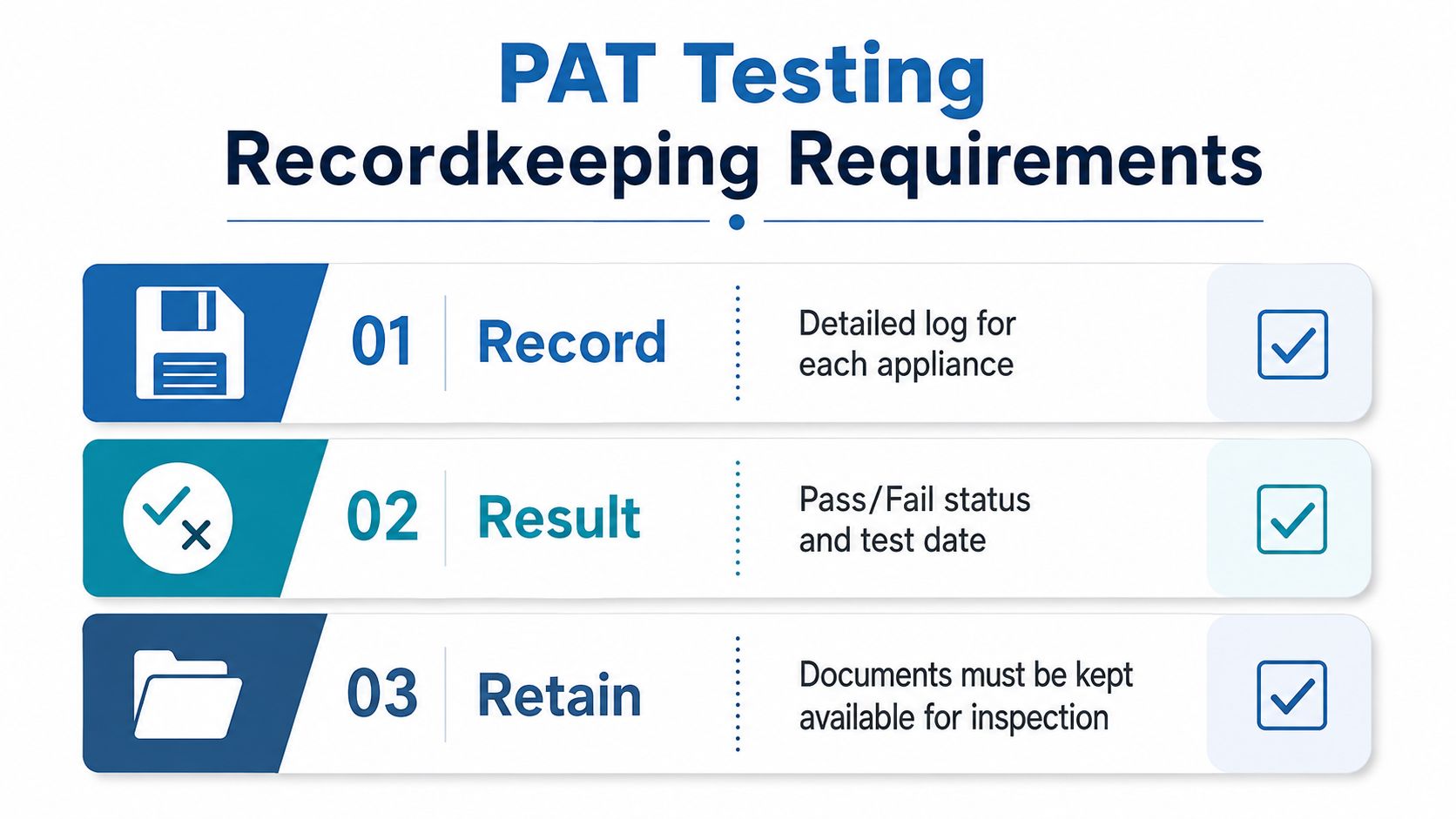
A graphic outlining PAT testing recordkeeping requirements including documenting logs, test results, and maintaining accessible inspection records.

Good PAT records are what let you prove the work was done properly. In practice, that means keeping a clear trail for each appliance, each inspection, and each decision made after a failed result. A graphic outlining PAT testing recordkeeping requirements including documenting logs, test results, and maintaining accessible inspection records.

What the file should show

At a minimum, the record should identify the appliance, note the date it was checked, state the result, and name the person who carried out the work. A certificate or log entry that ties the result to a specific inspection date is far more useful than a loose note saying the item was “checked.”

A failed item needs a clear paper trail too. The log should show that it failed, what happened next, and whether it was taken out of use, repaired, or retested. That matters because equipment that is not safe on the day cannot stay in service on the strength of a shrug and a promise to fix it later.

A good digital system keeps this tidy without much effort. Each appliance should have its own entry, with photos, test results, follow-up notes, and any repair history stored in one place. If a landlord or business owner is managing several sites, separate folders or site tags help prevent confusion between offices, apartments, shops, and storage areas.

How good records help in real life

Clean records do more than satisfy an inspection. They show that the person in charge took reasonable care, and they give you something solid to point to if a dispute arises after a fault or incident.

They also make day-to-day management easier. If you have multiple premises around Dublin, the system should let you see what was tested, what failed, what was repaired, and what still needs attention without digging through loose certificates or old emails.

Digital records are usually easier to search, sort, and back up than paper files, but the format is not the main issue. A messy spreadsheet with missing entries is no better than an untidy folder. What matters is that the trail is complete, readable, and easy to produce when someone asks for proof.

Common Exemptions and Edge Cases

Not every item on a premises needs PAT testing. One of the most useful Irish nuances is that equipment that's rarely moved and protected from damage should not need to be tested unless a risk assessment shows otherwise, according to TU Dublin guidance used in Irish PAT arrangements. That's a useful counterweight to the blanket annual testing myth, and it stops people wasting time on items that aren't really in scope.

What usually falls outside the PAT conversation

Fixed installations are a different issue from portable appliances, so don't mix the two up. A hardwired system, a distribution arrangement, or other fixed electrical work belongs in a different compliance bucket. PAT testing is aimed at portable items, the sort of things you plug in and move around.

New equipment also gets misunderstood. Being new doesn't make an appliance exempt forever, but it can influence the risk picture if the item is low-risk, undamaged, and used in a controlled setting. Battery-powered devices can fall outside normal plug-in PAT thinking, though they still need a sensible safety review where they're being used around staff, tenants, or contractors.

Domestic, landlord, and contractor situations

Homeowners often ask whether every appliance in the house needs to be tested. In a normal domestic setting, that's not how Irish workplace PAT rules operate. Landlords need to think more carefully about what they supply in rental property, while businesses need to look at employee use, visitor use, and contractor equipment separately.

Practical point: if you don't own the appliance, and it's not part of your workplace supply, it usually isn't your PAT responsibility.

That doesn't mean you ignore it. It means you separate ownership, location, and duty of care before you book a test. For example, landlord-supplied items in a rental unit deserve a different approach from a tenant's own charger or laptop. Contractor tools are again different, especially where several firms are on site and temporary electrics are being used.

A proper assessment saves money. You only test what falls within the scope, and you set the interval according to risk instead of habit.

Compliance Checklist and Next Steps

If you want a defensible PAT system in Dublin, keep it simple and organised. Start with a risk assessment, then work outward from there. A sensible programme is easier to maintain than a rushed annual batch of tests no one can explain later.

Compliance checklist graphic for homeowners, landlords, and businesses to ensure regular electrical safety testing requirements.

A practical checklist

  • Identify the appliances: List the portable equipment you control, including landlord-provided items, staff equipment, and site tools.
  • Set the risk level: Look at how often the item is used, where it's used, and whether it gets moved, handled, or exposed to moisture.
  • Choose a competent person: Use someone who understands the equipment class, the risks, and the required documentation.
  • Build the schedule: Match the interval to the risk profile, not to a generic annual rule.
  • Keep the records: Hold onto certificates and test logs for 5 years so you can produce them if needed.
  • Review the plan: Revisit the schedule when the environment changes, new equipment arrives, or an item fails.

If you need a provider, choose a contractor who can explain the rationale behind the schedule, not just the test itself. In Dublin and North County Dublin, that usually means a Safe Electric registered team that understands Irish compliance and issues paperwork you can use. You can also check Forward Electrical's electrical contractors registration page if you're comparing what a registered contractor should be able to provide.

When a business or landlord gets this right, PAT testing stops being a headache. It becomes a routine safety control that fits the property instead of fighting it. If you're unsure what applies to your premises, or you've got mixed equipment across offices, apartments, or worksites, arrange a professional assessment before the next inspection catches you out. For practical help with testing, records, and compliance in Dublin, visit Forward Electrical and talk to a qualified electrician who works with Irish regulations every day.