Blog

Commercial EV Charger Installation in Dublin: Guide

You've got staff asking where the EV bays will go, a fleet manager looking at electric vans, or a property owner wondering whether the existing car park can support charging. The natural first thought is to choose a charger and get it fixed to the wall.

On a commercial site in Dublin, the charger is usually the straightforward part. The difficult questions involve available electrical capacity, the route from the intake to the parking spaces, trenching, planning, grant approval, network controls and certification. A sound project answers those questions before equipment is ordered.

Table of Contents

What a Commercial EV Charger Project Actually Involves

Most commercial EV charger installations start with a site that looks simpler than it is. An office may have a convenient wall beside the staff car park, but the distribution board could be full, the incoming supply may have little spare capacity, or the proposed cable route may cross a busy access road. A depot might have plenty of land, yet need substantial civil works before a single van can charge.

The work normally moves through a connected sequence:

  • Site survey: The contractor checks the intake, distribution boards, parking layout, cable routes, communications coverage and practical working conditions.
  • Load assessment: Existing building demand is reviewed alongside the proposed charging load, with consideration for future bays and load management.
  • Grid discussion: Where supply capacity is uncertain, the contractor may need to raise a query with ESB Networks before the design can be finalised.
  • Design and equipment selection: Charger output, mounting, protection, access control, billing and smart charging are matched to how the site will operate.
  • Civil and electrical works: The build may include dedicated circuits, board upgrades, ducting, trenching, feeder pillars, plinths and surface reinstatement.
  • Funding and compliance: Grant forms, product eligibility, planning checks and certification need to be handled in the correct order.
  • Testing and handover: The installation is commissioned, documented and handed over for daily operation and future maintenance.

A small staff installation can often be planned over a few weeks, while a multi-bay depot may take several months. The timing is usually controlled by paperwork, supply capacity and ground conditions, not by the time needed to mount the charging unit.

Practical rule: Don't buy the hardware before the contractor confirms the supply, cable route and grant position. A charger that suits a brochure may not suit your building.

The project typically involves the client, a Safe Electric Ireland registered contractor, ESB Networks where supply changes are needed, the charger or network provider, and sometimes the local authority. Agreeing who owns each task at the outset prevents the familiar late-stage problem where everyone assumes somebody else has dealt with planning, grant approval or communications.

Site Survey and Load Assessment

A proper survey is where a commercial project earns its reliability. The contractor isn't just measuring the distance to the nearest wall socket. They're establishing whether the building can safely support the intended charging load and what needs to change before construction begins.

What the electrician checks on site

The first inspection normally includes the main intake, meter position, main switchgear and existing distribution boards. The electrician looks for spare capacity, suitable ways for new protective devices, the condition of equipment and the available space for additional boards or control equipment.

The incoming supply matters. A site with a single-phase supply needs a different design from one with three-phase power, particularly where several vehicles need to charge together or where higher-output equipment is being considered. The contractor also reviews the building's normal demand, because spare capacity isn't the unused space in a board. It's the capacity that remains after existing loads and operating conditions are taken into account.

An inspector in safety gear performing a site survey for commercial EV charger installation at an office.

Why the parking plan affects the electrical design

The proposed bays should be marked on a site plan, not chosen only because they're closest to the reception entrance. Cable length, vehicle movement, accessibility, lighting, protection from impact and future expansion all affect the layout.

A competent survey records the route from the electrical source to each charger location. It identifies whether cables can run through existing ducts, along a building façade, overhead where appropriate, or below ground. It also flags surfaces that may be difficult to reinstate, such as concrete, tarmac, paving or areas.

Have the following ready before the visit:

  • Existing information: Incoming supply details, electrical drawings, board schedules and any previous upgrade records.
  • Operational plans: Vehicle numbers, staff parking patterns, delivery schedules and whether customers or visitors will use the chargers.
  • Site documents: A current parking plan, property boundaries and details of planned building works.
  • Future requirements: Any intention to add more bays, battery storage or other significant electrical loads. A discussion about commercial battery storage systems can be useful where charging and energy management are being considered together.

The survey should produce more than a charger count. It should give you a design basis, a list of assumptions, a clear note of constraints and a sensible route to an ESB Networks capacity query if one is required.

Choosing the Right Charger Type and Power Level

The right power level depends on how long vehicles remain on site, not on the highest figure printed in a supplier's catalogue. A car parked throughout the working day has a very different requirement from a delivery van that returns briefly between routes.

AC charging is generally the practical starting point for offices, workplaces, hotels and many depots. Lower-output equipment can work well when dwell times are long, particularly when several bays share the site's available capacity through load management.

Comparing common commercial options

A 7kW single-phase AC charger suits a staff bay, landlord-controlled parking area or small workplace where vehicles remain parked for several hours. It places a more modest demand on the supply than higher-output alternatives, although the final design still needs proper protection and load assessment.

A 22kW three-phase AC charger can suit commercial fleets and destination sites where vehicles need more energy during the day and the building has suitable three-phase capacity. The vehicle itself must also be able to accept that rate, so the charger's rating alone doesn't determine the actual result.

A DC rapid charger changes the nature of the project. It suits fleet operations, busy customer sites and short turnaround use, but it can require much more substantial electrical infrastructure, careful demand management and a stronger business case. It isn't automatically the best choice for a workplace where cars sit all day.

Power Level Typical Use Case Approximate Range Added Per Hour
7kW single-phase AC Staff parking, workplace bays and long-dwell destination charging Depends on the vehicle, battery and charging conditions
22kW three-phase AC Commercial fleets and sites with suitable three-phase supply Depends on the vehicle's onboard AC capability
DC rapid charging Fleet turnaround and short-stay customer charging Depends on charger output and the vehicle's DC acceptance

Features that matter after installation

For several bays, ask about dynamic load balancing. This allows the system to share the available electrical capacity instead of treating every charger as if it will run at full output at the same moment. It can make a phased rollout more practical, but it doesn't remove the need for a properly calculated design.

Network connectivity, user access, payment controls, usage reporting and remote fault alerts should be selected around the operating model. Staff-only charging may need simple identification and reporting, while a public-facing retail site may need payment processing and clearer user controls.

A mixed installation can be sensible. For example, a depot may use AC chargers for overnight parking and reserve rapid charging for vehicles on tight schedules. Identical units are easier to manage, but a mixed fleet can match different dwell times more effectively.

Electrical Infrastructure Upgrades and Civil Works

Once the design is agreed, the project becomes a coordinated building job rather than a simple electrical call-out. The contractor may run dedicated circuits from the main intake, install a sub-board closer to the car park, upgrade protective equipment or create a new distribution point for the charging area.

What the electrical build includes

The installation method depends on the site. Wall-mounted chargers can reduce the need for standalone supports where a suitable structure is nearby. Open car parks often need feeder pillars, pedestal-mounted units, impact protection and underground ducting. Larger layouts may require separate containment routes for power and communications.

The electrician sizes cables, protection and switching equipment to the approved design. Where the existing board has no suitable spare ways, an upgrade may be needed. Where the distance is long, the voltage drop and cable route can influence the choice of distribution point as much as the charger's headline power.

Why the ground works cause surprises

Trenching is where an apparently tidy quotation can meet the site. Before excavation, the contractor needs to consider existing services, drainage, lighting cables, water mains, telecoms routes, access requirements and the depth and construction of the surface. A drawing may show a clear route, while the ground reveals unrecorded concrete or an old service crossing the intended line.

Shared routes can make a multi-bay project more efficient because one properly designed duct route may serve several chargers. That doesn't mean every future bay should be connected immediately. Installing suitable ducting and leaving capacity for expansion can reduce later disruption, provided the design and funding position support it.

Expect the work to be coordinated around the business:

  • Access control: Parts of the car park may need to close while excavation or lifting takes place.
  • Surface reinstatement: Tarmac, paving, concrete and landscaping each require different repair approaches.
  • Weather planning: Wet conditions can affect excavation, concrete and reinstatement.
  • Business hours: Hotels, retail sites, offices and depots may need phased work to keep vehicles moving.
  • Safety management: Barriers, signage and controlled work areas protect staff, visitors and the installation team.

A Safe Electric Ireland registered contractor should manage the electrical construction, testing and certification. The client should receive clear notice of any change caused by ground conditions or concealed services before additional work proceeds.

Permits, Planning and Irish Building Regulations

Commercial charging projects in Ireland sit at the intersection of electrical compliance, grant conditions, planning and building requirements. These aren't separate boxes to tick at the end. The order matters because grant approval may need to come before electrical work, while the design must already reflect the building and site rules.

The checkpoints that protect the project

For Irish commercial installations, three technical checks deserve early attention:

  • Contractor registration: The charger should be installed by a Safe Electric Ireland registered contractor.
  • Product eligibility: The equipment should appear on the SEAI Triple E Product Register where the relevant scheme requires it.
  • Approval timing: Grant approval must be received before work starts. Beginning early can put eligibility at risk.

Planning permission depends on the property and the scope of works. Some charge points may be exempt, but a business shouldn't assume that a larger car park rollout, new structures or changes to the site can proceed without a local planning check. The practical answer is to have the contractor identify the planning question early and involve the local authority where necessary.

A six-step infographic showing the permits, planning, and Irish Building Regulations process for installations.

The parking thresholds businesses should know

For non-residential buildings with more than 20 parking spaces, the EU Energy Performance of Buildings Regulations require at least one recharging point in existing buildings by 1 January 2025, as set out by the Irish Government's regulations announcement. That threshold is directly relevant to many Dublin offices, retail properties, hotels and managed commercial car parks.

The rule differs for buildings containing one or more dwellings. Where a new building or major renovation has more than 10 parking spaces, ducting infrastructure must be installed for each car parking space to allow later charger installation, rather than requiring a charger at every space immediately, under the Irish statutory regulations.

Larger non-residential new-build or major-renovation projects with more than 10 spaces can also involve a recharging point and ducting for future provision. The exact application depends on the building type and works, so use the design stage to confirm the position rather than relying on a general assumption. Forward Electrical's overview of Irish electrical regulations can provide useful background, but site-specific planning and compliance questions should be checked professionally.

Grants, Funding and Cost Considerations

Funding affects the design before the first cable is installed. In Ireland, the SEAI Workplace Charging Grant covers up to 60% of eligible installation costs, capped at €5,000 per charge point, according to the Irish grant guidance. The important operational condition is that approval must be secured before electrical work begins.

The usual order is practical:

  1. Assess demand and capacity: Confirm how many vehicles need charging and what the site can support.
  2. Check eligibility: Review the grant conditions and equipment requirements.
  3. Obtain approved installer quotations: The scope should identify charger hardware, electrical work and civil works clearly.
  4. Submit the application: Wait for approval before starting electrical work.
  5. Build and document: Keep the invoices, photographs and completion evidence needed for reimbursement.
  6. Submit the completion pack: The grant administrator assesses the evidence before payment.

A funnel diagram explaining the financial breakdown and grant support for commercial EV charger installation projects.

A separate ZEVI commercial charging support scheme offers up to €4,000 per charger and funding for up to 40 chargers per site, as described in this Irish commercial charger installation guide. That cap and site limit influence how a multi-bay project is phased. A business may decide to install the operationally essential bays first, while preparing ducting and board capacity for later expansion.

Funding point: A grant reduces eligible expenditure, not every item that appears on a contractor's invoice. Design, trenching, board changes, surface repairs and network services need to be checked against the relevant scheme.

The final project cost depends on the number of bays, charger type, cable distance, ground conditions, distribution board work, communications and smart charging controls. A short route to a suitable board may be relatively uncomplicated, while a distant car park with difficult excavation can change the balance completely. A clear breakdown is more useful than a low headline figure that excludes the work needed to make the chargers function safely.

For a separate discussion of the variables involved, see this guide to EV fast charger installation cost.

Testing, Certification, Handover and Ongoing Maintenance

A charger isn't ready for business use when the screen lights up. The final stage confirms that the installation is safe, the controls work as designed, the network is configured correctly and the client has the records needed to operate and maintain the asset.

What happens before handover

The contractor tests the new circuits, protective devices, earthing arrangements, isolation points and charger operation. Each unit is commissioned against the agreed settings, including power limits, access permissions, load balancing and any billing or reporting functions.

The installer also checks practical operation. Cables should sit safely in their holders, bays should be clearly identified, protective posts should be secure where required, and users should understand how to start and end a session. A depot needs a different handover from a hotel or office. Fleet managers may need user permissions and charging schedules, while facilities teams may focus on fault alerts, resets and access to monitoring data.

A diagram illustrating the five-step process of commercial EV charger installation, testing, certification, and ongoing maintenance services.

The documentation pack should be treated as part of the installation, not an afterthought. It may include:

  • Electrical certification: Safe Electric certification and relevant test results.
  • As-installed information: Final circuit details, board identification and charger locations.
  • Product records: Manufacturer information, serial numbers, warranties and approved settings.
  • Operating details: Network account information, user access arrangements and support contacts.
  • Maintenance records: Inspection recommendations, service notes and any outstanding observations.
  • Grant evidence: Invoices, photographs and completion documents required by the funding scheme.

Safe Electric certification is particularly important for the owner and the facilities team. It demonstrates that the electrical work has been tested and recorded by the registered contractor, and it gives the next electrician useful information if the site is expanded or altered later.

Why maintenance protects availability

Commercial chargers live in exposed and busy environments. They face rain, dirt, repeated cable handling, vehicle movement and occasional impact. A fault that would be a minor inconvenience at home can become an operational problem when employees depend on the bays or a depot needs vehicles ready for the next route.

A planned maintenance arrangement gives the site a defined way to deal with inspection, cleaning, protective equipment, firmware or network issues and physical damage. The right schedule depends on the equipment, location and usage, so it should be agreed with the installer and manufacturer rather than copied from another site.

Software monitoring can identify chargers that are offline, repeatedly failing sessions or losing communication. Remote information doesn't replace an electrician, but it can help the facilities team distinguish a user issue from a hardware or supply fault and arrange the right response sooner.

Handover advice: Ask who receives the fault alert, who is authorised to attend, what information the service provider needs and how a charger is taken out of use safely after impact damage.

Load management should also be reviewed after the site is occupied. The original design may have been based on expected staff, visitor or fleet demand. Actual usage can reveal that some bays are heavily used while others sit idle, or that charging schedules need adjustment to avoid unnecessary simultaneous demand.

A practical project checklist

Before asking for a quotation, prepare:

  • A site plan: Mark parking spaces, proposed charger positions, access routes and any areas that can't be closed.
  • Electrical records: Provide incoming supply information, board schedules and details of other planned electrical loads.
  • Usage requirements: Explain who will charge, when vehicles arrive and leave, and whether payment or access control is needed.
  • Expansion plans: State whether more bays may be needed later, even if the first phase is modest.
  • Funding questions: Ask which scheme may apply, what evidence is required and when approval must be secured.
  • Planning questions: Confirm whether the proposed layout, mounting and civil works need local authority review.
  • Handover expectations: Request certification, test results, warranties, operating information and maintenance recommendations.

Common concerns usually have a practical response. If the existing supply is too small, the contractor can investigate load management, a phased rollout or an ESB Networks capacity route. If planning is unclear, pause the build long enough to obtain a site-specific answer rather than risking a late change. If the budget is tight, prioritise the bays that solve the immediate operational need and design the containment and distribution with sensible future provision.

The SEAI Commercial Fleet Trial report gives useful context for Irish operators. It engaged 187 businesses, and participants drove an average of over 3,000 km every three months, with charging needed about every three days. 92% of charging took place on chargers provided at business premises or at home, while the recorded average three-month distances were 3,700 km for cars and 4,400 km for vans. Estimated tailpipe emissions avoided over the trial period were 512 kg for cars and 529 kg for vans. For a business considering fleet electrification, that supports a straightforward design question: what can be charged reliably at the workplace or depot?

A commercial EV charger installation should therefore finish with more than working equipment. It should leave the owner with a tested electrical system, clear certification, a usable operating model and a maintenance route that keeps the charging bays available.


Forward Electrical provides commercial EV charger installation, site assessment, electrical infrastructure work and certified handover support for businesses across Dublin and North County Dublin. If you're planning staff, visitor or fleet charging, visit Forward Electrical to discuss your site, grant requirements and the right next step with a Safe Electric registered contractor.

PAT Testing Dublin: A Practical Guide for 2026

You're a Dublin landlord handing over keys, a café owner getting ready for an inspection, or an office manager dealing with a faulty charger. Suddenly, someone asks for PAT records, and a simple question follows: what needs testing, how often should it happen, and what paperwork should you keep?

The honest answer is more practical than a blanket annual rule. PAT testing in Dublin is a risk-based part of workplace electrical safety, shaped by the equipment, its environment and how heavily it's used. The right programme protects people and gives you organised evidence that unsafe items have been identified and dealt with.

Table of Contents

Why PAT Testing Matters in Dublin Properties

A landlord in a Dublin terrace may only think about portable appliances when a tenancy changes. A café owner might start looking for records before an insurance inspection, while an office manager may take action after a kettle trips a socket or a laptop charger shows a damaged lead. These situations are common reasons PAT testing moves from the bottom of a maintenance list to the top.

The concern isn't the certificate by itself. It's whether equipment used by tenants, staff or customers remains safe in the conditions where it operates. A charger sitting on a desk in a quiet office has a different exposure to wear than an extension lead dragged across a busy hospitality floor or a power tool used on a fit-out.

Practical rule: PAT testing works best as an organised maintenance habit, not as a last-minute search for paperwork.

Irish workplace safety duties sit within a wider legal framework, rather than a standalone voluntary scheme. You can read more about the Irish electrical regulations affecting workplace safety if you're trying to understand how portable equipment fits alongside other electrical responsibilities.

The risk is often ordinary wear

Many defects are visible before a meter is connected. Frayed cables, loose plug tops, scorch marks, cracked housings and strained connections can develop through everyday handling. A professional inspection gives those defects a defined route: record the item, assess it, remove it from service where necessary, and arrange repair or replacement.

That matters across Dublin property types. Tenants depend on safe appliances, employees use office equipment for long periods, and customers may come into contact with equipment in cafés, salons, shops and venues. A clear register also helps a property manager see which items were checked, which failed, and what still needs attention.

PAT testing doesn't replace sensible visual checks or proper maintenance. It gives the business or property owner a repeatable way to manage portable equipment and demonstrate that electrical safety is being taken seriously.

What PAT Testing Actually Covers

Portable appliance testing is a professional inspection and testing process for electrical equipment that can be moved, or that is connected to an installation by a flexible cable. In a Dublin workplace, that can include kettles, monitors, laptop chargers, extension leads, printers, vacuum cleaners, power tools and portable kitchen equipment.

The word “portable” doesn't only mean something small enough to carry under one arm. A treadmill in a gym, for example, may stay in the same position for long periods but still connect through a flexible lead and remain exposed to movement, impact or cleaning activity. A competent person considers how the item is supplied, used and exposed to deterioration.

An infographic detailing the three-step PAT testing process for electrical safety compliance in Ireland.

Visual inspection comes first

A qualified tester normally begins with the condition of the appliance, cable and plug. That examination can identify:

  • Damaged leads: Cuts, exposed conductors, crushing or heat damage can make an item unsafe.
  • Plug problems: Loose connections, damaged plug tops or missing parts need attention before use.
  • Signs of overheating: Scorching, discolouration or a burnt smell may indicate a developing fault.
  • Mechanical damage: Cracked cases, loose covers and damaged strain relief can expose users to danger.

Electrical testing follows where appropriate. Irish PAT guidance identifies checks such as earth continuity, insulation resistance, protective conductor current, touch current and earth leakage, depending on the appliance and the risks involved. These tests help a competent person assess whether protective arrangements and insulation remain suitable.

PAT testing isn't a fixed-wiring inspection

A PAT visit focuses on portable equipment. It isn't the same as a periodic inspection of the fixed installation, and a PAT certificate doesn't confirm that the distribution board, sockets, lighting circuits or concealed wiring are in good condition.

The HSA's electricity guidance lists installation tests including continuity, resistance or conductance, polarity, fault loop impedance and RCD operation in the context of post-installation testing. That's a different scope from portable appliance testing, so a business may need both forms of assessment.

The useful question is not whether every appliance has a sticker. It's whether the equipment has been identified, inspected, tested where suitable, and managed according to its actual working environment.

The Irish Legal Framework for PAT Testing

Irish law requires inspection and testing when electrical equipment is exposed to conditions likely to cause deterioration. The main framework is the Safety, Health and Welfare at Work Act 2005 and the Safety, Health and Welfare at Work (General Application) Regulations 2007, specifically S.I. No. 299 of 2007. These regulations took effect in November 2007 and set workplace duties relevant to portable equipment. The Irish PAT testing requirements should therefore be read alongside the wider employer safety obligations.

The duty generally rests with the employer when equipment is supplied for use at work. The employer must arrange periodic inspection and testing by a competent person where the working conditions could cause deterioration. The rules apply specifically to portable equipment supplied above 125 volts AC. Any inspection or test certificate should identify the item and cover its cables and plug tops, so far as could reasonably be established on the inspection day. The Irish PAT testing guidance on equipment and inspection duties explains these requirements in practical terms.

A flowchart explaining the Irish legal framework for portable appliance testing in the workplace.

The legal trigger is exposure to deterioration

A controlled Dublin office, a busy café, a rented apartment under active management and a construction site present different conditions for electrical equipment. Moisture, heat, dust, vibration, movement, impact, frequent handling and cleaning can all affect the inspection approach. The property type matters because it helps establish how equipment is used, who handles it and what records the employer needs.

Irish law does not set one fixed interval for every appliance. “Periodically” requires a suitable inspection and testing arrangement based on risk, equipment type and use history. An annual visit may be sensible for some workplaces, while another setting may call for a different frequency. The competent person and responsible manager should be able to explain the choice rather than rely on a sticker date alone.

A written risk assessment should record:

  • The equipment: construction, electrical class, age and previous defects.
  • The environment: heat, moisture, dust, movement, impact and cleaning routines.
  • The users: staff, contractors, tenants, students or members of the public.
  • The history: earlier failures, repairs, repeated faults and changes in use.

That record gives a Dublin business a clear basis for scheduling inspections, retaining certificates and showing why its maintenance arrangements match the conditions on site.

Who Needs PAT Testing in Dublin

The need for PAT testing is easiest to understand by looking at the premises and the people using the equipment. A private landlord, office manager and construction contractor may all manage portable appliances, but their exposure to wear and the records they need can differ substantially.

An infographic highlighting the necessity of PAT testing for landlords, offices, retailers, and construction sites in Dublin.

Landlords and residential properties

A landlord renting a Dublin apartment or house should separate two questions. First, is the equipment being supplied for use in a workplace? Secondly, what appliances are being provided to tenants, and what condition are they in?

Domestic landlord duties can depend on the circumstances, so a PAT label shouldn't be treated as a substitute for broader electrical safety checks. Where a landlord supplies appliances as part of a managed rental property, keeping an inventory and records of condition is sensible, particularly for older kettles, washing machines, heaters, chargers and extension leads.

Offices and coworking spaces

Office equipment often includes monitors, desktop computers, laptop chargers, printers, desk lamps, kettles and extension blocks. The environment may be relatively controlled, but shared equipment changes hands frequently and cables can be moved, trapped or damaged under desks.

Some Dublin-sector guidance commonly uses 48 months for certain class 1 stationary or IT equipment, while other moveable items may be managed at 24-month intervals, depending on risk and the equipment category. These examples come from Irish PAT testing interval guidance, not from a universal statutory timetable.

Retail, hospitality and construction

Retail units and cafés combine staff use with public access, frequent cleaning and busy working areas. Kitchens can expose appliances to heat, moisture, grease and impact, so the risk assessment should reflect those conditions rather than copy an office schedule.

Construction and fit-out sites are more demanding again. Tools, extension leads and portable equipment may be moved between areas, exposed to dust and knocks, and connected in changing conditions. Records should identify each item clearly, show its result and make it easy for supervisors to remove failed equipment from service.

What Happens During a PAT Test Visit

A professional PAT visit usually begins with an agreed scope. The tester and site contact identify the rooms, storage areas, shared appliances and equipment that contractors or staff bring into the premises. Good preparation means appliances are accessible, but staff don't need to dismantle anything or carry out electrical work.

The tester then creates or updates an asset register. Each item receives an identifiable record, often including its description, location, asset reference and test outcome. A record that lets someone find the exact appliance later is more useful than “kettle in the kitchen”.

The inspection and testing sequence

The process normally follows a logical order:

  1. Visual assessment: The tester checks the appliance, cable, plug, casing and visible signs of damage or overheating.
  2. Instrument testing: Where appropriate, test equipment checks electrical safety characteristics relevant to the item.
  3. Result recording: The tester records whether the item passes, fails or needs further action.
  4. Identification: Suitable labels or other markings link the physical appliance to its test record.
  5. Documentation: The customer receives the agreed certificate, report or asset register.

Some appliances may need to be unplugged briefly. A tester can often work room by room so staff can continue with minimal disruption, but a busy kitchen, retail floor or workshop may need a quieter appointment time. The sensible arrangement depends on access, the number of items and whether equipment is essential to daily operations.

A failed item shouldn't receive a new label after a quick reset. It should be clearly identified, removed from service where necessary, and assessed for repair or replacement by a qualified person. Re-certification should follow only after the defect has been properly addressed.

What Drives PAT Testing Cost in Dublin

The cost of a PAT job depends on the work involved, not just the number printed on a quote. A small office with accessible equipment is a different assignment from a café where appliances are distributed through a working kitchen, or a construction site where tools and leads require careful identification.

The main factors include the following:

Cost Driver Why It Matters Typical Effect on a Quote
Number of items More appliances require more inspection, testing and records. More labour and documentation.
Appliance mix Different classes and designs may require different checks. Greater testing complexity.
Access Items hidden under desks, behind counters or in storage take longer to locate. Longer attendance time.
Working environment Kitchens, workshops and construction areas can require more careful handling. Increased time and planning.
Scheduling Out-of-hours visits may be needed to avoid interrupting trading or staff work. Additional scheduling complexity.
Reporting format Asset registers, certificates and itemised reports require organised data. More administration where detailed records are requested.

The cheapest quote may not be the most useful if it provides only a sticker and no clear register. Ask whether the service includes visual inspection, appropriate electrical tests, defect identification, an itemised report and a format your manager can maintain.

Bundling PAT testing with planned electrical maintenance can improve efficiency where the same contractor is already attending the property. Splitting work across different visits may suit a large operation, but only if the records clearly show what has been tested and what remains outstanding.

Certification, Records and Choosing a Contractor

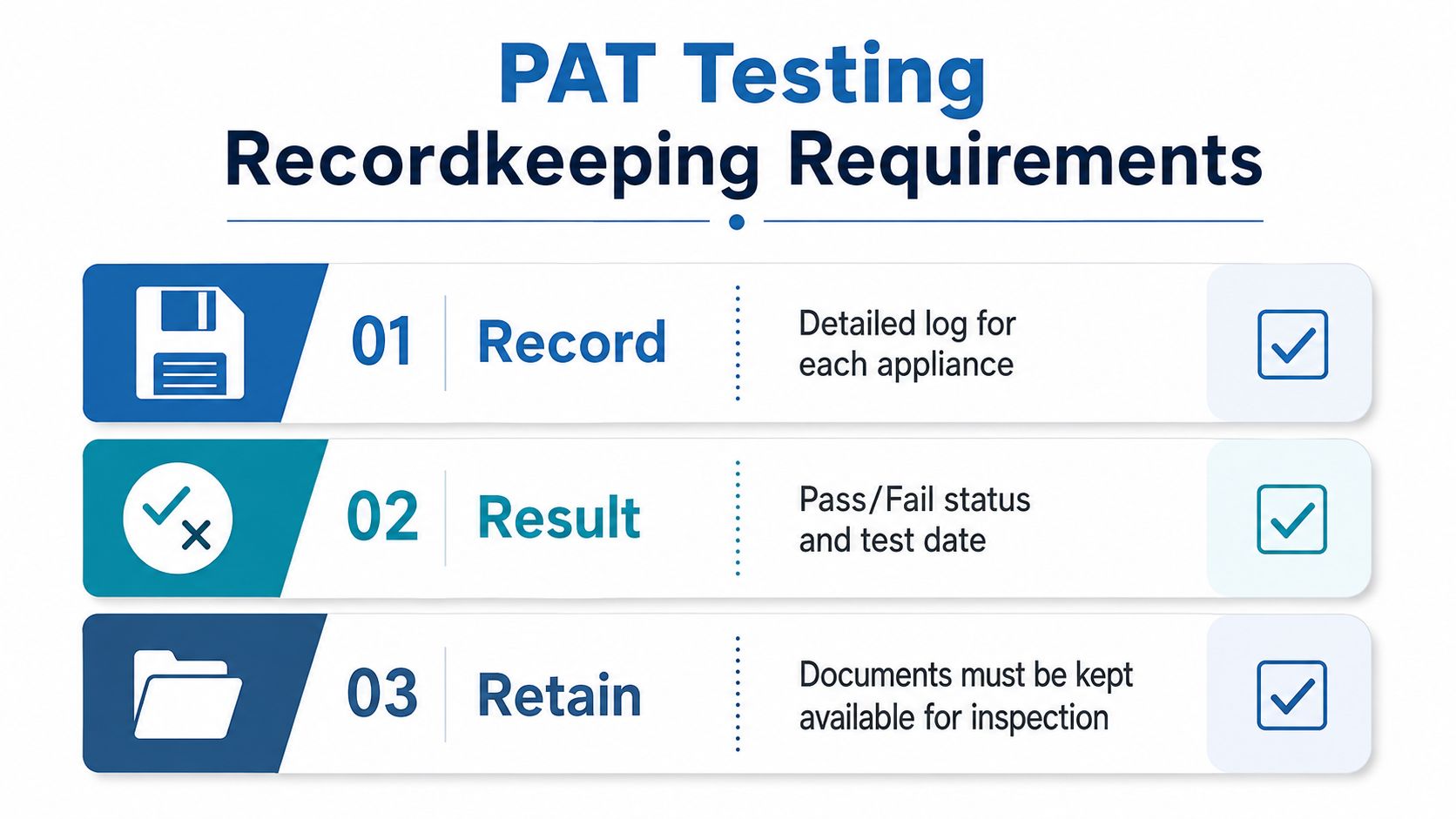
Paperwork is part of the safety system. Under the 2007 General Application Regulations, records of inspections and tests must be kept available for at least 5 years, as set out in Irish PAT testing regulatory guidance. University guidance in Dublin also states that PAT inspection results should be recorded and retained for the lifetime of the equipment, and made available for inspection by the Health and Safety Authority.

That longer approach is practical. If an appliance remains in service, its history can show repeated checks, earlier defects, repairs and changes in location. A current pass label tells you what happened on the inspection day. A properly maintained asset register tells you how the item has been managed over time.

An infographic outlining the essential requirements for record-keeping and selecting a qualified contractor for electrical safety testing.

What to ask before booking

A suitable contractor should be able to explain:

  • Who will attend: Check qualifications, relevant experience and whether the person is competent for the equipment and environment.
  • What the report includes: Ask for an itemised register, test results, failed-item details and any recommended action.
  • How defects are handled: Confirm that unsafe equipment is identified clearly and not left in normal use.
  • What registration applies: For wider electrical work, check whether the contractor is a Safe Electric registered contractor and whether the team has suitable RECI qualifications.
  • What insurance is held: Request confirmation that appropriate public liability and professional cover are in place for the work being undertaken.

Forward Electrical provides PAT testing for commercial and domestic properties as part of its Dublin electrical services, alongside broader inspection and maintenance work. A contractor's usefulness is measured by the clarity of the records left behind, not merely by how quickly labels are applied.

Common Questions About PAT Testing in Dublin

Does a domestic landlord always need PAT testing?

Not every domestic rental situation follows the same workplace rule. A landlord should consider the appliances supplied, the tenancy arrangement and the risks presented, then obtain qualified advice rather than assuming that a PAT label alone settles every electrical responsibility.

Does PAT testing replace a wiring inspection?

No. PAT testing concerns portable equipment. Fixed wiring, sockets, protective devices and the wider installation require their own inspection and testing where appropriate.

What happens when an appliance fails?

The item should be identified clearly and removed from service where it presents a safety risk. A qualified person can then assess whether repair is suitable or whether replacement is the safer option. The register should record the outcome.

How often should records be reviewed?

Review them whenever equipment changes, a fault occurs, the environment changes or an earlier inspection identifies repeated problems. The inspection interval should reflect risk, not an automatic annual assumption.

If you're responsible for a Dublin home, rental property, office, shop, café or worksite, Forward Electrical can advise on the portable equipment in scope, organise professional PAT testing and provide clear records for ongoing maintenance. Visit Forward Electrical to request advice or arrange a suitable booking.

Electrician Balbriggan

Electrical services in Balbriggan

Balbriggan Electrician

Electrical repairs, property services and commercial project support in Balbriggan from a Safe Electric Registered contractor.

Balbriggan Electrician
Safe Electric Registered
Domestic and commercial
Clear quotations
Testing and documentation
Local electrical support

Domestic and commercial electrical support in Balbriggan

We assess each property individually, whether the requirement is a household fault, rental-property repair, electrical upgrade or planned commercial project.

Domestic electrical repairs

Fault finding, tripping circuits, lighting, sockets and damaged electrical accessories.

Fuse boards and upgrades

Assessment of distribution equipment, circuit protection and appropriate replacement work.

Rental and managed property

Repairs, remedial work, changeover items and coordinated property access.

Commercial services

Maintenance, lighting, power, fit-outs and planned electrical upgrades.

Electrical services

Electrical work in Balbriggan

The appropriate scope depends on the installation, access, existing condition and work required.

Electrical repairs and fault finding

Investigation and repair of tripping circuits, loss of power, damaged accessories and recurring faults.

Fuse boards and circuit protection

Assessment, repair and replacement of distribution equipment and protective devices.

Lighting and power

New points, alterations, lighting repairs, controls and practical upgrades.

Inspection and testing

Condition assessment, testing and clearly recorded findings for suitable domestic and commercial work.

Landlord and property services

Electrical work for rentals, managed properties, changeovers and recorded remedial items.

Commercial electrical support

Fit-outs, maintenance, upgrades and electrical installations for business premises.

How it works

From enquiry to completed electrical work

Send enough information for us to understand the property and decide whether a site assessment is required.

Share the details

Provide the address, property type, issue or proposed work, photographs and access information.

Assess and quote

We review the requirement, arrange a visit where needed and define the appropriate scope.

Schedule the work

Agree access, timing, isolations and any preparation needed before attendance.

Complete and record

Carry out the work, inspect and test it, then provide relevant completion information.

Coverage

Nearby areas we serve

Forward Electrical works across its established service area. Contact us with the exact address so availability can be confirmed.

The right service

Domestic, property and commercial support

For larger projects, include drawings, reports, site contacts and intended dates. For repair work, describe the fault and whether any immediate safety concern exists.

Send project details
Common questions

Balbriggan electrician FAQs

What electrical services are available in Balbriggan?
Services include fault finding, repairs, fuse-board work, lighting, power, landlord services, renovation work and commercial electrical support.
Do you provide emergency repair support?
Responsive support is subject to location and current availability. If there is smoke, fire or immediate danger, keep clear and contact the emergency services.
Can you replace an old fuse board?
Yes, after assessment of the existing installation and any related remedial requirements.
Do you work with landlords and agents?
Yes. Forward Electrical supports repairs, remedial work, electrical changes and planned property programmes.
Can you install home EV chargers?
Yes, subject to assessment of the property, off-street parking, cable route and electrical capacity.
How can I request a Balbriggan quote?
Send the full address, property details, intended work, photographs and preferred timing through the quote form.
Book electrical work

Need an electrician in Balbriggan?

Tell us about the property, electrical issue or planned project and your preferred timescale.

Electrician North Dublin

Domestic and commercial electrician

Electrician North Dublin

Electrical repairs, upgrades, property services and commercial projects across North Dublin, delivered by a Safe Electric Registered contractor.

Electrician North Dublin
Safe Electric Registered
Domestic and commercial
Clear quotations
Testing and documentation
Local electrical support

Local electrical support across North Dublin

Forward Electrical supports homes and business premises across established North Dublin locations, with scopes adapted to the property and work required.

Homes and landlords

Electrical repairs, alterations, upgrades and property-related work.

Commercial premises

Maintenance, fit-outs, power, lighting and planned improvement projects.

Managed properties

Clear coordination, access planning and relevant work records.

Project work

Site assessment, agreed scope, installation, testing and handover.

Electrical services

Electrical work in North Dublin

The appropriate scope depends on the installation, access, existing condition and work required.

Electrical repairs and fault finding

Investigation and repair of tripping circuits, loss of power, damaged accessories and recurring faults.

Fuse boards and circuit protection

Assessment, repair and replacement of distribution equipment and protective devices.

Lighting and power

New points, alterations, lighting repairs, controls and practical upgrades.

Inspection and testing

Condition assessment, testing and clearly recorded findings for suitable domestic and commercial work.

Landlord and property services

Electrical work for rentals, managed properties, changeovers and recorded remedial items.

Commercial electrical support

Fit-outs, maintenance, upgrades and electrical installations for business premises.

How it works

From enquiry to completed electrical work

Send enough information for us to understand the property and decide whether a site assessment is required.

Share the details

Provide the address, property type, issue or proposed work, photographs and access information.

Assess and quote

We review the requirement, arrange a visit where needed and define the appropriate scope.

Schedule the work

Agree access, timing, isolations and any preparation needed before attendance.

Complete and record

Carry out the work, inspect and test it, then provide relevant completion information.

Coverage

North Dublin areas

Forward Electrical works across its established service area. Contact us with the exact address so availability can be confirmed.

The right service

Domestic, property and commercial support

For larger projects, include drawings, reports, site contacts and intended dates. For repair work, describe the fault and whether any immediate safety concern exists.

Send project details
Common questions

North Dublin electrician FAQs

Which parts of North Dublin do you cover?
Established coverage includes Swords, Malahide, Portmarnock, Donabate and surrounding North Dublin areas, subject to availability.
Do you work in both homes and businesses?
Yes. Forward Electrical provides domestic, landlord, property-management and commercial electrical services.
Can you repair electrical faults?
Yes. Fault finding can cover tripping circuits, loss of power, damaged accessories and recurring electrical issues.
Do you replace fuse boards?
Yes, following assessment of the existing installation and required scope.
Do you install EV chargers?
Yes. Home and commercial EV charger projects are available subject to site and capacity assessment.
How do I get a quote?
Send the address, property type, work details, photographs and preferred timing through the quote form.
Book electrical work

Need an electrician in North Dublin?

Tell us about the property, electrical issue or planned project and your preferred timescale.

Electric Shower Installation Dublin: A Complete Guide

Electric shower fitting in Dublin typically costs €250 to €600, with Dublin labour often carrying a 10% to 15% premium over national pricing, and most straightforward jobs are finished in 2 to 3 hours on site. That's the budget conversation most homeowners want first, because the key question isn't just what the unit costs, it's whether the house is ready for one.

A tired shower tends to show up at the worst time, usually on a cold morning when the bathroom is already uncomfortable and the water pressure feels patchy. A quick search can make the job look simple, but an electric shower installation Dublin job is rarely just a unit swap. The safer way to approach it is to look at property suitability, circuit capacity, compliance, and long-term running cost before anyone lifts a tool.

An infographic explaining why electric shower installation in Dublin requires a professional certified electrician.

Table of Contents

Why Electric Shower Installation Is Serious Electrical Work

A lot of Dublin homeowners start with the same thought. The old shower is weak, the bathroom's cold, and replacing the unit sounds like a tidy half-day job. In practice, this is one of those tasks where the visible appliance is only part of the story, because the shower sits at the meeting point of water, heat, and a high electrical load.

That's why Irish rules treat this as restricted electrical work. Safe Electric says anyone carrying out restricted electrical works must be registered, and its shower guidance says the job must be done by a Safe Electric Registered Electrical Contractor. If the work is being done properly, it also has to align with I.S. 10101:2020 and the normal certification chain for electrical work in Ireland, not just the manufacturer's box contents. Safe Electric's restricted works guidance is the key reference here, and it's the reason this job is not handled like a simple bathroom fixture replacement.

Practical rule: if a shower is being fitted in a bathroom, it's not enough to “make it fit”. The installation has to suit the circuit, the room, and the dwelling.

The risk is straightforward. Bathrooms are wet areas, shower units draw substantial power, and a small mistake can create nuisance tripping at best, or an unsafe installation at worst. That's also why many electricians begin by checking the existing shower point, the circuit, and the bathroom arrangement before they even quote.

If you're comparing this work with other domestic electrical upgrades, the logic is similar to a consumer unit job in one important way. The installation is only as good as the system behind it, which is why many homeowners also check related work such as a fuse board upgrade when the house is older or the electrical history is unclear.

How Much It Costs to Run an Electric Shower

The running cost is the part that catches people out. Installation is a once-off job, but the shower may be used every day, and over time that operating cost can matter more than the fitting bill. In Ireland, Electric Ireland lists an electric shower at 9 kWh and €3.13 per hour based on its standard €0.3475/kWh residential rate including VAT, as of November 2024, while Energia estimates about €0.56 for a 10-minute shower and about €3.39 for a full hour of use. Those figures show why an electric shower can become one of the highest-running-cost bathroom appliances. Electric Ireland's bathroom energy guidance is the clearest published reference on this point.

Why the electricity bill matters more than the fitting bill

If a household uses the shower daily, the annual operating cost can build up significantly. That doesn't mean electric showers are a bad choice, but it does mean the decision should be based on how the property is used, not just on what is cheapest to install.

In many Dublin homes, the upfront quote is only half the conversation. The real question is whether the property will suit the shower type for years to come.

A family home with heavy morning use might prioritise reliability and availability over low running cost. A landlord turnaround might value speed and straightforward replacement. A smaller household may care more about installation simplicity than operating expense, but the figures above still matter because the shower is part of the monthly utility spend, not a decorative upgrade.

An infographic showing the cost of running an electric shower in Ireland per ten-minute session.

Is Your Dublin Home Actually Suited to an Electric Shower

The biggest mistake is assuming every bathroom can take the same answer. A shower unit might look like the obvious replacement, but the key question is whether the house can safely support it. That's especially relevant in older Dublin housing stock, where supply capacity, earthing, and older bathroom layouts can change the job completely.

What gets checked before a quote

Independent Dublin-specific guidance says installers should inspect the existing shower point, cable size, protective device, isolation, water supply, and bathroom condition before quoting, and that older Dublin properties can present supply-capacity and earthing challenges. That's the sensible order, because a shower replacement that ignores the underlying installation can leave the same weak point in place. Forward Electrical's shower installation guidance reflects the sort of checks a competent installer will make on a first visit.

A property with low water pressure, awkward cabling routes, or a tired earthing arrangement may need more than a straight swap. In some cases, a different shower type or a circuit upgrade is the honest answer. That's not bad news, it's just the point where a proper assessment saves time and repeat call-outs.

The right shower is the one the property can safely support, not the one that looks easiest to buy.

Older terraces and some rental properties in North County Dublin can be particularly revealing on inspection. You might find the bathroom itself is fine, but the electrical side needs attention before any new unit should go in. That's why a professional site visit should focus on suitability first and product choice second.

Safety Rules and Bathroom Zones Explained

Bathrooms use zone-based safety distances for a reason. The layout tells the electrician where equipment can go, what protection it needs, and how close various fittings can be to the wet area. NICEIC's bathroom guidance says Zone 0 is inside the bath or shower tray, Zone 1 extends to the highest fixed shower head or 2.25 m from the floor, and 230V socket outlets may only be installed 3 m horizontally from the boundary of Zone 1. NICEIC's bathroom guidance is a useful plain-English summary of those spacing rules.

The electrical protection matters just as much. In Ireland, an electric shower should be treated as a dedicated final circuit, protected by a 30mA RCD or RCBO, and installed to I.S. 10101:2020 by a Safe Electric registered contractor. Safe Electric's own guidance also says every circuit in a room containing a bath or shower should have a dedicated 30mA RCD, including lighting, electric showers, and heated towel rails. That protection is there to disconnect quickly if an earth fault occurs.

What a compliant installer is checking

A proper installer is looking at the circuit arrangement, the protective device, and the bathroom layout together. For example, a shower on the wrong circuit, or a fitting placed without respect for the zone boundaries, can create avoidable problems later. In workplace settings, Irish HSA guidance is even more explicit about electrically heated showers and pumps for electrically operated showers in Zone 1 needing an RCD of no more than 30 milliamperes. HSA's I.S. 10101 guidance is the clearest route back to the Irish standard.

If you're also dealing with ventilation issues, a bathroom project often makes sense as a joined-up job. A well-planned bathroom extractor fan installation can help protect the room from moisture while the shower work is being sorted.

Typical Cost of Electric Shower Installation in Dublin

A realistic budget starts with the property itself, not the shower model on the box. In older Dublin homes, the price can shift quickly if the circuit is cramped, the consumer unit needs attention, or the bathroom layout makes access awkward, so a quick replacement and a proper corrective job are often two very different quotations. HomePros' 2026 shower installation guide gives a published range that is useful for setting expectations.

The lower end usually fits a straight swap where the existing wiring, isolator, and shower point are in decent condition. The higher end usually appears when the installer has to deal with extra testing, awkward routing, old accessories that no longer suit the setup, or other issues that only become clear once the job is opened up.

Dublin Electric Shower Installation Cost Factors Typical effect on cost Typical Dublin impact
Longer cable run More materials and labour Raises labour time in older layouts
Consumer unit upgrade Extra work and certification Can move the job beyond a simple replacement
Earthing or bonding issues Additional safety work Common reason for a wider scope
Old isolator replacement Extra parts and testing Often found in older bathrooms
Awkward bathroom access Slower installation Can push the quote higher

A separate Dublin trades guide puts an electric shower circuit install at €300 to €500, usually allowing 2 to 3 hours on site, but that range only suits jobs where the existing arrangement is already in good shape. A quote should say clearly what is included, what testing is covered, and what would trigger extra work once the electrician sees the bathroom in person.

That is the point where the cheap quote can stop being the cheap quote. Missing earthing, a marginal circuit, or a worn isolator can change a tidy replacement into a wider repair job, and the final bill follows the actual condition of the property, not the first number on the page.

What Happens on the Day of the Installation

A straightforward shower replacement is usually well contained if the circuit is suitable. The electrician arrives, reviews the bathroom and the existing equipment, and checks the job against the supplied details before any work starts. If something in the existing setup doesn't suit, that gets identified early rather than halfway through the visit.

A step-by-step infographic illustrating the professional electric shower installation process from assessment to final handover.

The practical sequence on site

The first stage is arrival and assessment, where the electrician confirms the shower location, access, and existing circuit arrangement. After that comes safe isolation, because no one should be working on a live high-load bathroom circuit. Only then does the installation itself begin, followed by testing and certification before the bathroom is left tidy.

Cable and protective-device selection are not chosen by guesswork. In Dublin installations, guidance says the shower's kW rating, cable run length, and voltage drop govern the setup, and typical 8.5 to 10.5 kW units commonly use 10mm² cable with a 45A double-pole isolator. Stamford Electrical's fitting guide is a good reference for the sort of specification checks a professional makes before sign-off.

If the shower fits neatly and the circuit is sound, the day should feel organised, not dramatic.

At the end, the homeowner should receive the relevant paperwork for the work completed. That certification matters because it shows the installation has been checked and signed off as part of the proper compliance process, not just visually finished.

How to Choose the Right Installer in Dublin

The installer matters as much as the shower. A competent contractor will talk about Safe Electric registration, ask about the existing circuit, and explain whether the work is a straightforward replacement or something that needs extra electrical attention. If the conversation skips straight to “we can fit anything”, that's usually not the conversation you want.

The questions worth asking

Ask whether the installer will confirm compliance with I.S. 10101:2020, whether testing and certification are included, and whether the quote covers likely extras such as a circuit upgrade or replacement isolator. Those questions are practical, not fussy. They tell you whether the person pricing the job has assessed the installation or just priced the appliance.

It also helps to look at local experience. Dublin homes are varied, from newer estates to older terraces, and the differences matter when a wet-room-style bathroom or a legacy supply is involved. If you want a local team that handles compliant domestic electrical work, Forward Electrical's registered contractor service is one option, alongside other Safe Electric registered contractors in the city.

What good paperwork and advice look like

A proper quotation should be clear about the scope, the protection measures, and any known limitations. It shouldn't leave the earthing, circuit capacity, or bathroom zoning as surprises on the day. If the installer can't explain those parts in plain English, they probably haven't looked closely enough.

Planning Your Next Steps With Confidence

The smartest way to approach an electric shower installation Dublin job is to start with the house, not the brochure. Check whether the bathroom layout, supply capacity, and existing circuit are likely to suit the job, then decide whether you want a direct replacement or a wider electrical fix. That order saves time and avoids paying twice for the same problem.

Gather any paperwork you already have on the shower circuit or consumer unit, because it helps a contractor understand the starting point. Then think about the unit size in two ways, performance and running cost, since a shower that looks good on day one can be expensive to live with if the household uses it heavily.

A written quotation from a Safe Electric registered Dublin electrician should spell out the work, the checks, and any likely extras before anyone starts. If the property is older, or if the shower has been weak for some time, ask for the installer's view on suitability first. That small conversation often tells you more than a product page ever will.

If you'd like a practical assessment of your shower circuit, Forward Electrical can review the existing setup, explain what's suitable for your home, and carry out compliant installation work across Dublin and North County Dublin. Visit Forward Electrical to arrange a site visit or ask for straightforward advice on your bathroom electrical work.

Fuse Box Replacement in Dublin: A Homeowner’s Guide

The phone rings, someone's kettle trips the lights, and suddenly the old board in the hall becomes the most important thing in the house. That's a familiar Dublin job, especially in homes where the original board has been sitting there since the house was built, doing its best while the rest of the home has moved on. By the time a homeowner starts asking about fuse box replacement, it's usually because something's already looking unreliable, or because a survey, renovation, or recurring trip has forced the issue.

A lot of people still call it a fuse box, and in everyday speech that's fair enough. In the trade, though, what matters is whether the installation is still doing its job safely and whether the work needed is treated as a compliance-led upgrade rather than a simple hardware swap. In Ireland, that distinction matters, because the work sits under the consumer unit framework in the current rules for electrical installations, and it has to be handled and certified properly by a registered contractor under the Safe Electric system, as outlined in the Irish guidance on modern replacement work fuse box replacement and Irish compliance.

If you're staring at a board that looks dated, smells warm, or keeps causing nuisance trips, you're not alone. The sensible question isn't just, “Can this be patched?”, it's, “Is this still the right board for the house I've got now?” That's the line that separates a quick repair from a proper upgrade.

Table of Contents

When a Dublin Homeowner Starts Thinking About the Fuse Box

A typical call comes from a house that's been standing for decades, maybe a terraced place in Drumcondra or a family home in Tallaght where the board has outlasted several kitchens and a few generations of appliances. The lights haven't exploded, nothing dramatic has happened, but the owner has noticed the same little annoyances again and again. A circuit trips when the oven and kettle run together. The board looks tired. Someone says, “We probably should get that checked.”

That's usually the right instinct. Most homeowners don't think about the board until there's a fault, but the better time to look at fuse box replacement is before an emergency forces the decision. Planned work gives you time to compare quotes, ask the right questions, and understand whether the installation is still fit for modern use.

A board that's only being discussed after repeated faults has usually already told you enough.

The point of this guide is simple. You should come away knowing what a fuse box does, when replacement makes more sense than repair, and why the job in Ireland is treated as a regulated electrical upgrade. You'll also see what a professional replacement looks like on the day, how certification works, and how to judge the electrician who's quoting for the work.

If your home is older, or if the board has never been changed since it was installed, it's worth paying attention now rather than waiting for a full breakdown. A quiet board can still be unsafe, and a noisy one is usually asking for a proper look.

What a Fuse Box Actually Does in Your Home

A checklist infographic outlining warning signs that indicate a home fuse box may need replacement or repair.

Think of the board as the central control point for the house's electrical circuits. It doesn't just feed power around the home, it also protects each circuit if something goes wrong. In older systems, that protection may come from rewireable fuses. In a modern consumer unit, it comes through breakers and residual protection devices that are designed to react more cleanly when there's an overload or fault.

That's why the language matters. In Ireland, what many people still call a fuse box is regulated as a consumer unit under the current National Rules for Electrical Installations, and replacement work is assessed against the modern framework rather than older legacy fuse-board standards. If you're reading a quote or report and the wording seems different from what you've always called the box in the hall, that's normal. The paperwork follows the regulated term, even when the kitchen-table language doesn't.

A homeowner doesn't need to memorise technical terms, but it does help to know the basic distinction. A fuse board is the older style, while a consumer unit is the modern distribution board with better protection and clearer circuit management. The key takeaway is that the board is there to stop a fault on one circuit from becoming a bigger problem in the rest of the house.

Practical rule: if the board is old enough that nobody can clearly explain its protection arrangement, it's due a professional inspection.

For a local reference point, the discussion of older Irish boards and modern consumer-unit upgrades is set out clearly in this guide to fuse boards in Ireland. That's the kind of terminology homeowners will see in quotes, certificates, and inspection notes, so getting comfortable with it saves confusion later.

The checklist below is a handy way to compare warning signs at a glance.

Warning Signs That Point to Replacement Rather Than Repair

A single blown fuse, or one nuisance trip after plugging in a heavy appliance, doesn't automatically mean the whole board has to go. A pattern of problems does. When I'm looking at an older Dublin installation, I'm asking whether the symptoms suggest one circuit fault, or whether the board itself is no longer the right piece of equipment for the house.

Recurring tripping is the first clue. If the same circuit keeps dropping out, it could be an appliance, a damaged cable, or an overloaded circuit. If several different circuits are misbehaving, or the trips are accompanied by other warning signs, the case for replacement gets stronger. Warm casing, buzzing, scorch marks, or a burnt smell are not “normal old-house quirks”. They're signs that need a proper electrician, not guesswork.

An infographic detailing nine warning signs that indicate it is better to replace equipment than to repair.

The signs that usually push the decision toward upgrade

Here's the practical sort-out I use with homeowners:

  • Repeated trips on more than one circuit. That often points beyond a simple nuisance fault and into capacity or ageing protection issues.
  • Heat, buzzing, or a discoloured cover. That suggests contact trouble or overload somewhere in the assembly.
  • Fuses that have been patched or bodged. Any sign of wire, foil, or improvised fixes means the board has been tampered with and shouldn't be treated casually.
  • Missing labels or unclear circuit identification. If nobody knows what each breaker does, safe isolation becomes harder and the installation is harder to manage.
  • An obviously old board. Age alone doesn't prove danger, but decades-old equipment is often out of step with what a modern home needs.
  • Scorch marks or a burning smell. That moves the situation from “keep an eye on it” to “get it assessed properly”.

Search results for generic fuse repairs tend to focus on the blown component, but they don't answer the homeowner's real question, which is whether the issue is local or systemic. The Irish guidance gap matters here, because older homes often still rely on legacy protection arrangements while current standards expect clearer circuit identification and safer isolation. In practical terms, if the board is showing heat, smell, repeated faults, or tampering, you're usually past the point of a minor tidy-up.

A professional electrician won't guess from the outside. They'll test, inspect, and decide whether the board can stay or whether the safer move is to replace it.

Why Modern Irish Homes Put Older Boards Under Pressure

The load on a house today is nothing like the load a lot of older Dublin homes were designed around. EV charging, electric heating, induction cooking, home offices, laptops, monitors, smart controls, and heavier appliance use all stack demand onto circuits that may have been laid out for a simpler life. That doesn't automatically mean the board is failing, but it does mean the old setup can be under strain.

The engineering point is straightforward in plain English. Every board has limits on how much current it can carry safely, and every protective device has to be able to cope with faults without becoming the weak link. In retrofit work, the new enclosure, incoming tails, and protective device need to work as a coordinated set. If one part is undersized, that part becomes the failure point.

The LV distribution specification from Electricity North West shows how far contemporary assemblies are expected to go, with fuse-box carriers listed at 82 mm, 200 A normal current rating, 300 A overload current rating, and 11.27 kA fault current rating LV distribution specification. That's a useful illustration of the engineering gap between modern expectations and older domestic panels, especially where the home has picked up extra demand over time.

If the home's electrical life has moved on but the board hasn't, the board is usually the first place the strain shows up.

A like-for-like replacement can be too shallow. If the old arrangement was installed for lighter household use, changing the front box without checking the broader setup can leave the core problem untouched. A proper electrician will look at the board in the context of the whole installation, especially where there are newer loads in the mix.

The practical point for a homeowner is simple. A fuse box replacement isn't only about making the hall cupboard look newer. It's about making sure the home's protective gear still matches how the house is used now.

What Happens During a Professional Replacement

A six-step infographic detailing the professional vehicle part replacement process from inspection to driving away.

A proper job starts before anyone lifts a lid. The electrician will usually inspect the existing setup, look at the board condition, and decide whether the swap is straightforward or whether hidden faults are likely to show up. On a clean installation, the job may be completed within a half-day to a full day, but older homes can stretch beyond that if testing finds weak points that need attention.

The homeowner side is pretty simple. You need access to the board, and you need to expect the power to be off for several hours while the work is being done. Someone should be available on site, because the electrician may need to check circuits, confirm labels, or talk through anything unexpected that turns up during testing.

The job itself

A qualified electrician will isolate the supply completely before any work starts, then confirm there's no voltage present with a certified tester. Only then will the old board be removed. The new consumer unit is fitted, circuits are connected in an orderly way, and the installation is tested before anything is put back into service.

That last part matters more than many realise. Safe isolation, installation, testing, and certification are the backbone of the job. The cited safety guidance says the old components are removed only after isolation, the new board is installed to the relevant wiring standard, and the installation is tested before it's energised again replacement safety and regulations.

The TE technical specification for modern fuse and relay box assemblies also shows that these are not loose, like-for-like swaps. The box has to suit the terminals, and the holder has to accept the correct fuse geometry and contact pressure. The document defines insertion force limits below 40 N for miniature fuses and below 55 N for medium fuses, with extraction-force windows set to protect the holder and maintain contact TE fuse and relay box specification. In plain terms, a compliant replacement has to fit, seat, and hold properly.

If you're getting a quote, the right question isn't just “How long will it take?” It's “What testing, labelling, and certification are included if the installation turns out to need more than a straight swap?”

Certification, Compliance, and the Safe Electric Route

Replacing a consumer unit isn't treated like fitting a shelf or changing a tap. In practice, it's notifiable electrical work and it has to be tested, certified, and properly recorded. That's the part homeowners sometimes find dull, but it's also the part that proves the work was done safely and to the right standard.

There are two routes people usually come across. A Safe Electric registered contractor can self-certify the work and issue the completion certificate directly. That's the cleaner route for most homeowners because the electrician handles the job and the paperwork in one process. If the work is done by someone outside that route, the Building Notice path is used instead, and an independent inspection follows after completion, which can add delay and extra administration. The trade guidance also notes that third-party inspection costs are commonly cited at £300 to £500 in the UK framework often referenced in Irish-facing compliance explanations consumer unit replacement compliance.

That doesn't mean every job looks the same. It does mean the homeowner should expect a proper paper trail. A finished job should leave you with proof that the board was installed, tested, and recorded, not just swapped and forgotten.

Certification isn't paperwork for paperwork's sake, it's the record that lets another electrician, surveyor, or buyer see what was done.

The practical difference is easy to spot. A registered contractor can usually move faster because the job and certification sit together. A non-registered route means more coordination, more checking, and more waiting for the independent sign-off. Either way, if anyone suggests skipping the certification side to make the job “simpler”, that's a red flag.

For homeowners comparing quotes, it helps to know what the contractor can self-certify and what extra inspection steps might be needed. The registered electrical contractor route is worth understanding before you commit, because certification is part of the value of the work, not an optional extra.

How to Choose the Right Electrician in Dublin

A good quote tells you more than a price. It tells you whether the electrician has looked at the installation, whether they understand the certification route, and whether they're comfortable explaining what happens if the board opens up bigger issues. If the answer to those questions is vague, keep looking.

The first filter is registration. You want someone who is set up to handle regulated domestic work properly, and who can explain how the board will be tested and certified. After that, look at the quote itself. A proper quote should itemise labour, materials, certification, and any possible remedial work, rather than burying everything under one lump sum with no detail.

What to ask before you book

  • Registration and competence. Ask how they're registered and who will certify the work.
  • Scope of the quote. Check whether testing and certification are included, and whether remedial work is provisional or fixed.
  • Proof of cover. A straightforward electrician should have public liability cover and be comfortable saying so.
  • Comparable experience. Ask if they've worked on similar Dublin properties, especially older terraces, semi-detached homes, or landlord rentals.
  • Plan for surprises. Good electricians will tell you what happens if they find weak bonding, damaged circuits, or a board that can't be safely reused.

Red flags are usually easy to spot. A quote that's strangely thin, a reluctance to talk about certification, or pressure to skip inspection steps are all signs to slow down. Electrical work in an older house often reveals more than the customer expected, so the contractor should sound calm and practical, not evasive.

One option many homeowners in Dublin consider is a local contractor who can inspect, replace, and certify the board as part of the same job. In that setting, Forward Electrical is one example of a Dublin team that handles consumer-unit replacement and related electrical work for homes and businesses, but the test is still the same, whether the contractor is local or not, can they explain the process clearly and stand behind the paperwork?

Your Next Steps as a Dublin Homeowner

If you're weighing up a board change, start with three questions. Is the board showing warning signs? Does the home's current load justify an upgrade? And is this likely to be a straightforward swap, or the sort of installation where hidden issues might surface once the work begins?

Once you've answered those, the next move is simple. Shortlist two or three electricians who can handle the compliance side properly, arrange a survey, and ask for a written quote that includes testing and certification. It's also worth planning your day around a several-hour power outage, because that's normal on a proper replacement job.

If you're comparing what the work might involve, the fuse board replacement cost guide for Ireland is a useful place to get familiar with the factors that affect scope, even before anyone steps through the door. That gives you a better basis for comparing quotes without getting distracted by the cheapest number on the page.

The key thing is not to let a tired board sit there until it fails in a messy way. If the house is old, the board is old, or the tripping has become part of daily life, get a qualified electrician to look at it properly and tell you whether repair, replacement, or broader remedial work makes the most sense.


If your board's been causing repeated trips, heat, or uncertainty, Forward Electrical can assess the installation, explain what's needed, and carry out certified consumer unit work where appropriate. If you want straightforward advice from a Dublin electrician who deals with these jobs every week, visit Forward Electrical and arrange a professional inspection.

Auto Electrician Dublin: Essential Guide for Car Owners 2026

You've got the warning light that won't clear, the window that's stopped moving, or a car that was fine yesterday and now won't start on a damp Dublin morning. That's usually the point where a driver realises the problem isn't just a battery or a blown fuse, it's something deeper in the car's electrical system. In a city where EVs are now a normal sight and electrical faults are more complex than they used to be, a good auto electrician Dublin search isn't about finding the cheapest call-out, it's about finding the right diagnosis.

Table of Contents

Recognising When Your Car Needs an Auto Electrician

A driver usually spots an electrical fault in a messy, inconvenient way. The dashboard light comes on, clears, then returns again. The car starts one day and refuses the next, then behaves as soon as the garage is booked. Windows stop working, interior lights flicker, or a warning message keeps returning even after a battery change.

The signs that point to electrical trouble

That pattern usually points away from a simple mechanical fault. Intermittent problems are often a giveaway, especially when the same symptom does not happen every time. A weak battery can cause trouble, but so can a parasitic drain, a wiring fault, a failing module, or a charging issue that only shows up under load.

Key tip, if the fault comes and goes, a specialist diagnostic check usually gives better value than another quick parts swap.

A general mechanic can handle many routine repairs, but electrical faults ask different questions. Is the alternator charging properly, is a relay failing, is a sensor signal missing, or is the body control system refusing to wake up? Those faults do not always leave obvious physical damage, which is why guesswork burns time and money.

Cold-start trouble can also look electrical when the cause is not simple at all. If the starter turns slowly, the lights dim heavily, or the car behaves oddly after short trips, it may need proper testing rather than a hopeful battery replacement. That distinction matters because modern cars can hide several small electrical problems behind one obvious symptom, especially as more systems depend on shared wiring, modules, and battery management.

When to stop treating it like a quick fix

A warning light is a clue, not a diagnosis.

That is the point many drivers miss. The light, the dead window, the flat battery, or the strange dash message is the start of the process, not the answer. A qualified auto electrician uses test gear to isolate the underlying fault before parts are replaced.

For Dublin drivers, this matters even more as vehicle electronics do more of the heavy lifting. The old habit of changing one part at a time can work for simple faults, but it is poor value once the issue involves control modules, charging systems, or battery drain that only appears overnight. Modern faults often need specialist equipment to read live data, check circuit behaviour, and find the underlying cause instead of hiding behind a symptom. When the signs are unclear, the car needs a proper electrical investigation, not another guess.

Core Services an Auto Electrician Provides

A proper auto electrical job starts with fault isolation, not parts shopping. The trade sits somewhere between electronics and vehicle repair, and the tools reflect that. Ammeters, voltmeters, oscilloscopes, wiring diagrams, and manufacturer test instruments are the backbone of the work, because a clean visual inspection alone won't tell you why a circuit is failing.

An organizational chart detailing the professional services offered by an auto electrician, covering diagnostics, installation, maintenance, and specialized systems.

Diagnostics before replacement

The first job is usually to prove where the fault sits. That can mean computer testing of electronic parts, checking supply and earth paths, or tracing a fault through a loom rather than blaming the most obvious component. Ace Motors describes its auto electricians as people who diagnose and repair or replace components causing electrical faults in motor vehicles, which is the right mindset for this trade.

That diagnostic approach matters with alternators and starter motors, but it matters just as much with wiring harness damage, ignition problems, dashboard faults, and stubborn battery issues. PSV.ie lists starter motor repairs, battery supply and fitting, alternator repairs, lights, spark-plugs, ignition systems, dashboard faults, switches, and electric window motors, which shows how broad the job can be. In practice, the customer brings in a symptom, and the electrician works backwards from that symptom to the actual failed point.

The systems that often need attention

Not every electrical fault is dramatic. A dead electric window, a flickering lamp, or a central locking issue can be the result of something small and local. Yet the same workshop may also deal with sensors, control systems, alarm faults, and immobiliser issues, where one failing signal can upset several other functions.

If the car has one fault that triggers another warning, the underlying problem is often electrical rather than purely mechanical.

That's why reputable shops don't treat every complaint as a battery issue. They'll inspect the circuit, test the component, and then decide whether repair or replacement makes sense. Larkin Automotive says its technicians repair and maintain electrical wiring and components in cars, vans and light commercial vehicles, while Ace Motors says it works on all makes and models of cars and vans. That broad coverage reflects the world of Dublin repairs, where one day might involve a family hatchback and the next a work van with a charging fault.

Why the tools matter

The best workshops aren't just carrying generic hand tools. They're using manufacturer-level test equipment, wiring data, and live readings to see what the car is doing, not what it's supposed to be doing. That difference is why a good diagnosis can save time and prevent unnecessary parts replacement. In electrical work, the right test often does more for the customer than the fastest guess.

How the EV Boom Is Changing Auto Electrical Work

A workshop in Dublin can no longer treat auto electrics as a simple battery-and-bulbs job. Ireland's vehicle parc is shifting, and the trade has shifted with it. Over 200,000 electric vehicles are now on Irish roads, which is above the Government action-plan target of 195,000, and battery-electric vehicles held a 21.56% share of the new-car market in the latest reporting period, according to RTE's reporting on the Irish EV market and registration figures RTE's report on electric cars in Ireland. For anyone looking for an auto electrician Dublin service, that means the work now reaches well beyond traditional 12-volt faults.

An infographic comparing traditional 12V vehicle systems with modern high-voltage electric vehicle diagnostics and required skills.

The work has moved beyond old assumptions

Charging faults, battery management problems, high-voltage isolation issues, software-heavy control systems, and electrified drivetrains now sit inside the modern electrician's day-to-day work. The older idea that auto electrics mainly means bulbs, batteries, and alternators leaves out a lot of what happens on Dublin roads now.

A basic fault can still be straightforward. An EV fault often is not.

That does not mean every EV issue has to go straight to a dealer. It does mean the person diagnosing it needs the right tools, the right training, and a careful approach to safety. Recent Irish coverage says the EV boom is increasing demand for specialist technicians while the country faces a training and skills shortage coverage of the technician shortage and EV expansion. In practice, that shortage shows up when drivers want someone who can explain the fault properly instead of just clearing a warning and hoping for the best.

Choosing the right level of specialist

If the issue is on the low-voltage side, such as lighting, accessories, or basic charging circuitry, an independent auto electrician is often the right first call. If the fault involves high-voltage safety systems, battery pack concerns, or complex EV software diagnosis, the job may be better suited to a dealer or a specialist EV technician.

If the fault could affect the battery pack, charging safety, or drive system, do not assume a general repairer is enough.

That is one of the biggest changes in the trade. Dublin's EV push is also driving more public charging and more home charging, so the car and the charging setup are now tied together more closely than before. The workshops that keep up with that shift are the ones most likely to give drivers a clear answer first time, because modern electrical work is about diagnosis as much as repair.

For readers planning charging at home or at work, the practical side of that transition is covered in Forward Electrical's EV charger Dublin information, because the car and the charging setup now sit much closer together than they used to.

Understanding Auto Electrical Costs and Call-Out Options

A driver usually asks about price first, and there is no honest fixed answer without looking at the car. A loose connection is one job. An intermittent module fault, a parasitic drain, or a charging issue hidden in the loom is another. The bill usually follows the time needed to trace the problem, the equipment required, and whether the repair needs parts, coding, or both.

An infographic comparing auto electrical cost factors and service options for car repairs in Dublin.

What changes the bill

The visible symptom is rarely the main cost driver. The actual cost sits in the testing behind it. One fault may be found quickly once the correct circuit is checked. Another may need repeated measurements, wiring comparison, component isolation, and live data reading before the cause becomes clear.

Vehicle complexity changes the job too. A modern car with several control units can take longer to diagnose than a simpler older model, even if both show the same warning light. Part choice matters as well, because genuine and aftermarket components do not behave the same way in fitting, compatibility, or long-term reliability.

Emergency call-outs also affect the total. If a car dies at the roadside, the first job is often to get it moving safely or make it recoverable, not to finish a full workshop diagnosis on the spot. The cheapest visit can cost more later if the same fault has to be tested again in the garage.

Workshop or mobile service

A workshop repair suits faults that need full test equipment, bench testing, or deeper investigation. The technician has more room, more tools, and better access to controlled diagnostics. Mobile service is useful when the car cannot easily move, when the fault is obvious on arrival, or when the first question is whether the vehicle is safe to drive or should be recovered.

A mobile call-out gives convenience. Workshop time gives depth of diagnosis.

That trade-off is where many drivers get caught. A mobile visit can be the right first step, but intermittent electrical faults often need a proper garage setup before they are solved properly. If you are comparing call-out pricing and want to see why the number changes with access, testing time, and job depth, call-out charges for electricians follows the same basic logic.

Dublin workshops also tend to work standard hours rather than around the clock. Hamilton's Auto Electric Ltd, for example, lists 6 Grantham Place, Camden Street, Dublin 2, with Monday to Friday hours of 9am to 5:30pm, while D Fitzgerald Autos lists Monday to Friday 9:00 to 18:00 and Saturday 9:00 to 17:00 Hamilton's Auto Electric Ltd. That matters when a fault appears on a Friday evening and you have to decide whether it can wait for proper diagnosis.

Choosing a Reliable Auto Electrician in Dublin

A reliable technician doesn't just say they can fix electrical faults. They show enough evidence that they've dealt with modern vehicle electronics before. In Dublin, that means checking for proper trade training, real diagnostic experience, and the equipment to back up the claim.

An infographic checklist for choosing a reliable auto electrician in Dublin, featuring icons and essential criteria.

What to look for first

Irish careers data show that employers commonly expect 3+ years of post-apprenticeship experience and a Level 6 / National Craft Certificate-level qualification for auto electrician roles CareersPortal's job detail for auto electrician work. That tells you the trade is technical, not casual. If a workshop is vague about qualifications, it's reasonable to ask what training and experience their staff have.

The other green flag is diagnostic capability. Modern faults need more than a test lamp and a guess. If a technician can talk clearly about manufacturer test instruments, live readings, wiring diagrams, and fault isolation, they're probably working at the right level.

A simple checklist to use

  • Certifications and Qualifications: Ask what trade training and recognised electrical qualifications the technician holds.
  • Experience with Your Vehicle Type: Make sure they've seen your make, model, or type of electrical fault before.
  • Diagnostic Equipment: Look for proper scanner access, voltage testing, and manufacturer-level tools.
  • Transparent Pricing: A good workshop explains how diagnosis is handled before parts are changed.
  • Warranty on Work: Ask what happens if the same fault returns after repair.
  • Customer Reviews: Check whether the feedback mentions diagnosis, communication, and finish quality, not just speed.
  • Insurance and Registration: Proper cover and registration matter when electrical work is being carried out in a workshop environment.

A useful sign of seriousness is whether the business is willing to explain the fault logically. If the answer is just “we'll replace the part and see,” that's weak on an intermittent electrical issue. If the person can explain why a fault could sit in the wiring, the module, or the component itself, you're dealing with someone who understands the trade.

For broader electrical work in homes and businesses, it's also worth checking Forward Electrical's registered electrical contractor information, because the same principle applies, proper qualification and traceable workmanship matter.

Common Questions About Auto Electrical Services

A van that won't start on a wet Dublin morning, a dashboard that lights up for no clear reason, or an EV that charges one day and refuses the next, these are the jobs that send people looking for straight answers. The main question is usually whether an independent auto electrician or a main dealer is the better choice for an EV fault. The honest answer is that it depends on the symptom. If the problem sits in low-voltage electrics, accessories, or basic charging and wiring issues, an independent specialist may be the better first call. If the fault involves high-voltage components, battery pack safety, or software-linked drivability problems, a dealer or dedicated EV specialist may be better equipped.

Fault codes are helpful, but they're not the full answer

Drivers often assume a code reader gives the whole story. It doesn't. A fault code usually points a technician in the right direction, but it doesn't always say which part failed or why it failed. That is especially true with intermittent faults, where the warning may appear after the underlying cause has already cleared itself.

A proper workshop will use the code as a starting point, then test the circuit, compare readings, and confirm whether the issue is in the wiring, the component, or the control system. Without that follow-up, people end up replacing parts that were never the actual problem. On modern cars and EVs, that means more time wasted and more money tied up in guesswork.

How mobile and workshop services differ

Mobile service suits faults where access matters most. A stranded vehicle, a driveway fault, or a simple on-site check can all be handled with a call-out visit. Workshop service makes more sense when the fault needs more time, more equipment, or deeper testing under controlled conditions.

The cheapest call-out is rarely the best value if the fault comes back the next day.

That is especially true for parasitic drain, CAN-bus faults, safety-system warning lights, and other intermittent issues. Those problems often need proper diagnosis rather than a quick visual check and a part swap. If a business cannot explain how it tests a fault, the job is probably not being investigated thoroughly enough. Good diagnosis takes time, and on newer EV-era systems, that time is usually cheaper than repeating the repair twice.

When to call sooner rather than later

If the problem affects starting, charging, lights, wipers, windows, or warning systems, do not let it linger. Electrical faults can stay minor for a while, then suddenly become inconvenient or unsafe. In Dublin, where many vehicles are doing short trips and repeated stop-start use, those issues tend to show up at the worst possible moment.

If your car's electrics are acting up, or you are trying to work out whether the fault needs a workshop diagnosis or a specialist EV check, contact Forward Electrical for practical advice and a professional look at the problem. Their team handles electrical fault-finding, installations, and repairs across Dublin, and they can help you decide what needs attention before the issue gets worse.

PAT Testing Requirements Ireland: A Practical Guide

Most advice on pat testing requirements Ireland gets one big thing wrong, it talks as if every portable appliance must be tested every year. That's not how the Irish system works. The actual rule is risk-based, so the right interval depends on the equipment, where it's used, how hard it's used, and its history, not a blanket calendar date.

For a landlord, business owner, or property manager in Dublin, that difference matters. It changes what you need to plan, what you need to document, and what you need to challenge when someone tries to sell you a one-size-fits-all schedule. It also explains why PAT testing is part compliance, part recordkeeping, and part sensible maintenance.

Table of Contents

The Truth About PAT Testing in Ireland

The first thing to get straight is this, Irish law doesn't create a universal annual PAT rule. The legal framework points you towards periodic inspection and testing by a competent person, then leaves the interval to risk assessment and the conditions on site.

That matters because a tidy office printer and a kettle in a busy staff kitchen do not carry the same risk. The law reflects that reality. A low-risk item that sits still in a clean environment can justify a very different schedule from hand tools, heaters, or equipment used in damp, crowded, or high-wear settings.

What that means in practice

If you're a landlord or business owner, PAT testing should not be treated as a tick-box job you do once and forget. It is an ongoing control, and the interval should make sense for the appliance and the environment. Irish guidance on Irish electrical regulations and compliance reflects the same principle, with office equipment often taking a much longer interval than equipment used by the public or on construction sites.

Practical rule: if you cannot explain why an appliance is on that testing cycle, you probably do not have a defensible cycle yet.

That is the difference between over-testing and proper compliance. Over-testing wastes time and money on low-risk items. Under-testing leaves gaps where faults can sit unnoticed until someone finds them the hard way. For employers, the point is not just to pass a test, it is to be able to show a sensible system when the HSA asks questions.

If you have only ever heard “annual PAT testing”, keep reading, because that shortcut can lead to poor decisions in both directions. The better question is whether your current setup can be justified on risk, usage, and records.

Legal Framework and Regulatory Requirements

Irish PAT obligations come from the Safety, Health and Welfare at Work Act 2005 and the Safety, Health and Welfare at Work (General Application) Regulations 2007, S.I. No. 299, which came into force in November 2007. The practical duty sits with employers and other duty holders, who must make sure portable equipment used in the workplace is periodically inspected and tested by a competent person. That framework is set out in the legislation summary at PATCert, and the wider compliance context is covered in Forward Electrical's Irish electrical regulations page.

The key point is that the regulations focus on workplace safety, not on one universal interval that suits every appliance. Compliance is not just booking a test and archiving the invoice. It means assessing risk, setting a sensible inspection cycle, and showing that unsafe equipment is taken out of use until it is made safe and recertified.

What employers have to do

The Irish regime creates a clear chain of responsibility. The employer identifies the equipment, the competent person inspects and tests it, and the records show what was checked and when. Where a certificate shows the equipment was not safe on the day of inspection, it has to be removed from use until it is made safe and recertified.

That is why PAT testing works as a governance tool as much as a safety check. It gives you evidence during an HSA inspection. It also gives you a defensible trail if a tenant, employee, insurer, or contractor asks what was done and when.

The document trail matters

Irish rules require inspection and test records to be kept for 5 years. That retention period turns PAT from a one-off maintenance job into an audit-ready control system, because you need to show continuity, not just a current certificate. In practice, you should be able to find the appliance, the result, the date, and the person who carried it out.

If the records are messy, the testing programme usually is too.

That is the standard I would use on a real job in Dublin. The law sets the framework. Good records show you have applied it.

What Adequate Inspection and Testing Involves

A proper PAT visit starts with a visual inspection, because many faults show up before any meter is used. The person doing the work needs to understand electrical, mechanical, and thermal damage, know the appliance class, and have enough experience to judge whether the item is still safe to keep in service, according to PAT Testers' guidance on who can carry out PAT testing.

An infographic illustrating the three steps of PAT testing: visual inspection, electrical testing, and using a competent person.

For portable equipment supplied at a voltage exceeding 125 volts AC, the same source says it should be inspected and, where appropriate, tested, with a certificate confirming that the equipment, including cables and plug-tops, was safe on the day of inspection as far as could reasonably be ascertained. That wording matters in real paperwork. It shows the condition at the time of testing, not a vague “all good” note that will not help you if an HSA inspector, insurer, or tenant asks for proof.

What a competent person looks for

A competent person is not just someone holding a tester. They need enough background to spot damage, interpret the results, and understand what matters for the appliance class. Irish guidance from DWSFS sets out the practical split between checks, with Class I items generally requiring earth continuity and insulation resistance checks, while Class II items focus on insulation integrity because they do not have a protective earth.

That distinction affects the job on site. A kettle, a desk lamp, and a double-insulated charger do not get treated the same way, even if they sit in the same office, rental property, or workshop. For a plain-English breakdown of the process, Forward Electrical's explanation of PAT testing is a useful reference point.

What you should expect to receive

A decent testing visit should leave you with more than a sticker on a plug. You should get a certificate or report that identifies the appliance, the date, the result, and the person who tested it. You should also expect any failed item to be clearly marked and removed from use until it is fixed and re-tested.

That paperwork is the point of the exercise. For businesses, it is the record that supports your position in an inspection or dispute. For landlords, it shows you took reasonable steps. For managers, it becomes the basis for the next testing cycle and helps keep the programme tidy enough to stand up to scrutiny.

Risk-Based Testing Frequencies by Equipment and Environment

Ireland does not use one fixed statutory interval for every appliance, and that is where a lot of people get caught out. The HSA approach is risk-based, so the right interval depends on the equipment, the environment, how often it is used, and its past condition. The practical guidance in circulation, including construction-focused advice from DLS Safety, shows that spread clearly.

Typical intervals by context

Equipment Type Environment Recommended Interval
Office equipment Low-risk office setting 2 to 5 years
Equipment used by the public Public-facing environment 12 months
Portable tools and equipment Active construction site Every 3 months

The table is a guide, not a substitute for judgment on the ground. A low-risk office workstation can justify a longer cycle, while a public-facing appliance or a site tool needs tighter attention because it sees more handling, more wear, and more exposure.

Why the environment changes everything

Heat, moisture, vibration, and frequent handling all increase the chance of damage. A back-office charger and a site saw should never sit on the same testing timetable. The guidance used in practice makes the same point, with frequency shaped by appliance type, usage intensity, environment, and history.

Good scheduling is conservative where the risk is higher, and less frequent where the risk is genuinely low.

For construction and multi-site commercial work, shorter cycles usually make sense for temporary tools, 110V site equipment, and anything that moves from one location to another. The same approach applies to retail rollouts, hospitality refurbishments, and short-term fit-outs in Dublin, where contractors, temporary leads, and heavy footfall all add to wear.

Annual testing is not a universal answer. It can be too much in one setting and not enough in another. A landlord with low-risk office equipment can often justify a longer interval if the condition record supports it. A workshop, a busy shop floor, or a damp site pushes the other way, because the use pattern and environment increase the risk of failure.

Recordkeeping and Documentation Requirements

A graphic outlining PAT testing recordkeeping requirements including documenting logs, test results, and maintaining accessible inspection records.

Good PAT records are what let you prove the work was done properly. In practice, that means keeping a clear trail for each appliance, each inspection, and each decision made after a failed result. A graphic outlining PAT testing recordkeeping requirements including documenting logs, test results, and maintaining accessible inspection records.

What the file should show

At a minimum, the record should identify the appliance, note the date it was checked, state the result, and name the person who carried out the work. A certificate or log entry that ties the result to a specific inspection date is far more useful than a loose note saying the item was “checked.”

A failed item needs a clear paper trail too. The log should show that it failed, what happened next, and whether it was taken out of use, repaired, or retested. That matters because equipment that is not safe on the day cannot stay in service on the strength of a shrug and a promise to fix it later.

A good digital system keeps this tidy without much effort. Each appliance should have its own entry, with photos, test results, follow-up notes, and any repair history stored in one place. If a landlord or business owner is managing several sites, separate folders or site tags help prevent confusion between offices, apartments, shops, and storage areas.

How good records help in real life

Clean records do more than satisfy an inspection. They show that the person in charge took reasonable care, and they give you something solid to point to if a dispute arises after a fault or incident.

They also make day-to-day management easier. If you have multiple premises around Dublin, the system should let you see what was tested, what failed, what was repaired, and what still needs attention without digging through loose certificates or old emails.

Digital records are usually easier to search, sort, and back up than paper files, but the format is not the main issue. A messy spreadsheet with missing entries is no better than an untidy folder. What matters is that the trail is complete, readable, and easy to produce when someone asks for proof.

Common Exemptions and Edge Cases

Not every item on a premises needs PAT testing. One of the most useful Irish nuances is that equipment that's rarely moved and protected from damage should not need to be tested unless a risk assessment shows otherwise, according to TU Dublin guidance used in Irish PAT arrangements. That's a useful counterweight to the blanket annual testing myth, and it stops people wasting time on items that aren't really in scope.

What usually falls outside the PAT conversation

Fixed installations are a different issue from portable appliances, so don't mix the two up. A hardwired system, a distribution arrangement, or other fixed electrical work belongs in a different compliance bucket. PAT testing is aimed at portable items, the sort of things you plug in and move around.

New equipment also gets misunderstood. Being new doesn't make an appliance exempt forever, but it can influence the risk picture if the item is low-risk, undamaged, and used in a controlled setting. Battery-powered devices can fall outside normal plug-in PAT thinking, though they still need a sensible safety review where they're being used around staff, tenants, or contractors.

Domestic, landlord, and contractor situations

Homeowners often ask whether every appliance in the house needs to be tested. In a normal domestic setting, that's not how Irish workplace PAT rules operate. Landlords need to think more carefully about what they supply in rental property, while businesses need to look at employee use, visitor use, and contractor equipment separately.

Practical point: if you don't own the appliance, and it's not part of your workplace supply, it usually isn't your PAT responsibility.

That doesn't mean you ignore it. It means you separate ownership, location, and duty of care before you book a test. For example, landlord-supplied items in a rental unit deserve a different approach from a tenant's own charger or laptop. Contractor tools are again different, especially where several firms are on site and temporary electrics are being used.

A proper assessment saves money. You only test what falls within the scope, and you set the interval according to risk instead of habit.

Compliance Checklist and Next Steps

If you want a defensible PAT system in Dublin, keep it simple and organised. Start with a risk assessment, then work outward from there. A sensible programme is easier to maintain than a rushed annual batch of tests no one can explain later.

Compliance checklist graphic for homeowners, landlords, and businesses to ensure regular electrical safety testing requirements.

A practical checklist

  • Identify the appliances: List the portable equipment you control, including landlord-provided items, staff equipment, and site tools.
  • Set the risk level: Look at how often the item is used, where it's used, and whether it gets moved, handled, or exposed to moisture.
  • Choose a competent person: Use someone who understands the equipment class, the risks, and the required documentation.
  • Build the schedule: Match the interval to the risk profile, not to a generic annual rule.
  • Keep the records: Hold onto certificates and test logs for 5 years so you can produce them if needed.
  • Review the plan: Revisit the schedule when the environment changes, new equipment arrives, or an item fails.

If you need a provider, choose a contractor who can explain the rationale behind the schedule, not just the test itself. In Dublin and North County Dublin, that usually means a Safe Electric registered team that understands Irish compliance and issues paperwork you can use. You can also check Forward Electrical's electrical contractors registration page if you're comparing what a registered contractor should be able to provide.

When a business or landlord gets this right, PAT testing stops being a headache. It becomes a routine safety control that fits the property instead of fighting it. If you're unsure what applies to your premises, or you've got mixed equipment across offices, apartments, or worksites, arrange a professional assessment before the next inspection catches you out. For practical help with testing, records, and compliance in Dublin, visit Forward Electrical and talk to a qualified electrician who works with Irish regulations every day.

What Causes Power Outages: Your Dublin Guide 2026

You're standing in the dark, the kettle has stopped mid-boil, and the only sound left in the house is the fridge going quiet. In a Dublin home, that moment usually brings the same question every time, is it just me, is it the street, or is the whole area down? The answer matters because the next sensible step is different depending on whether you're dealing with a local fault, a planned network action, or a wider grid problem.

Table of Contents

That Sudden Silence When the Power Goes Out

The first few seconds after a cut are always the same. Lights disappear, appliances stop, and everyone starts looking around as if the answer might be sitting on the counter. In a Dublin house, that silence can mean a simple local trip, a fault on your street, or a wider issue somewhere upstream.

Start with the obvious, then stay calm

The main thing is not to assume the worst. A power cut doesn't automatically mean your wiring has failed, and it doesn't automatically mean the national grid has collapsed either. Often, it's a protective device doing its job because something has gone wrong somewhere in the chain.

Practical rule: treat every outage as a safety question first, not a convenience issue. If you smell burning, hear crackling, or see heat at the consumer unit, stop there and call a qualified electrician.

What causes power outages varies by scale. Sometimes the problem starts far away, with generation or transmission stress, and sometimes it starts right inside a property at a consumer unit, service cable, or circuit fault. The job of a good electrician is to narrow that down safely, without guessing.

For Dublin homeowners, landlords, and business owners, that distinction matters. If the issue is local, you need fault-finding. If it's wider, you need confirmation from the network side before anyone starts reopening covers or resetting equipment.

The Big Picture Why Ireland Has Power Outages

Electricity in Ireland moves through a chain, from generation, into the transmission network, then into distribution lines, and finally to homes and businesses. A simple motorway analogy helps, generators are the source, transmission is the main motorway, and local distribution roads take power to each property. If there's a blockage at any point, the lights can go out downstream.

A four-step infographic showing how electricity travels from power generation to homes and businesses in Ireland.

Why the grid can be stressed even when nothing looks wrong on your street

EirGrid's Generation Capacity Statement 2024–2033 says Ireland had 8,601 MW of installed generation capacity in 2023, while peak demand in 2022 reached about 5,612 MW. That gap is useful, but it can still tighten when cold weather, unexpected plant failures, or faults on high-voltage lines put pressure on the system, which is why outages can start far from your home EirGrid capacity context.

That's the part many people miss. A property can have perfect internal wiring and still lose supply because the issue is higher up the chain. In practice, many Irish outages come from system-wide stress, not from a socket, switch, or appliance inside the house.

The motorway model helps explain why outages travel

If a generator trips, or a high-voltage line develops a fault, the effect can spread quickly. The same is true when reserve margins are tight, because the grid has less room to absorb another problem without taking load off somewhere else. That's why a cold spell can coincide with power cuts even when the weather outside your own window doesn't look dramatic.

For ordinary Dublin customers, the useful takeaway is simple. The power that arrives at your home depends on a whole network behaving properly, not just the wires in your walls. When that bigger system is under pressure, the outage may have nothing to do with your installation at all.

Common Culprits Behind Most Dublin Power Cuts

The most common causes of outages in Ireland aren't mysterious. They're usually weather, overhead line damage, vegetation contact, or equipment that's worn out enough to fail when stressed. In Dublin, that often shows up as lights going off after a storm, repeated interruptions on the same road, or a street that loses power while the one beside it stays on.

A pie chart infographic detailing the primary causes of power outages in Dublin, including weather and equipment failure.

Weather still does the most visible damage

Weather stress on overhead lines is the big one. Storms, strong winds, lightning, and tree contact can force conductors to flash over, break, or trip protection devices, especially on overhead rural and suburban feeders weather and overhead lines. That's why bad weather so often means multiple homes or whole areas lose supply at the same time.

The mechanism is straightforward. A branch touches a conductor, the line faults, and the protection opens to prevent worse damage. To the customer, it feels sudden. To the network, it's a controlled response to a fault.

Equipment failure is quieter, but it causes plenty of local trouble

Ageing transformers, switching gear, service cables, and low-voltage lines can fail without much warning. Technical reviews of outage causes point to maintenance-related issues, cabling faults, pole problems, and transformer defects as recurring categories outage cause review. In real terms, that's why one home can see flickering, intermittent trips, or voltage drop while the wider street seems fine.

That's also why repeated nuisance tripping shouldn't be dismissed as “just one of those things”. If the same circuit keeps acting up, the cause may be buried in ageing local hardware rather than the wider network. A qualified electrician can test that properly, something a homeowner shouldn't try to do on their own.

Vegetation, third-party damage, and other knock-on causes

Trees and branches don't need to hit a line directly to cause trouble. They can move into conductors in wind, or they can interfere with clearance enough to trip protection. Construction activity, vehicle strikes, and accidental damage can also knock out a local supply, which is why a roadworks site or an impact near a pole can lead to an outage that seems to come out of nowhere.

Animal interference does happen too, but it's not usually the first explanation I'd give a Dublin customer unless there's a clear local sign. More often, the pattern points back to weather, hardware wear, or a fault on the local distribution run.

See how fuse board issues can sit behind local power loss

Is It Just Your House or the Whole Street

The first question that comes to mind during a cut is the right one, is it isolated or widespread? You don't need technical training to make a safe first-pass judgement. You just need to look at the scope carefully and avoid touching anything you don't need to.

A five-step infographic showing how to diagnose a power outage by checking homes and electrical panels.

A quick decision tree that keeps you out of trouble

If the neighbours still have power, the issue is more likely local to your property. If the whole row or street is out, that points more towards a network fault or a planned action. That's the kind of basic split that helps you avoid guessing and wasting time.

  • Check nearby homes first: If lights are on next door, your issue is probably limited to your own installation.
  • Look at more than one room: If multiple circuits are dead indoors, the problem is bigger than a single lamp or appliance.
  • Check from a safe distance outside: A visual look at the meter box or service entry can reveal obvious damage, but don't touch anything.
  • Observe the consumer unit: A tripped switch or breaker can tell you a lot without opening up the system.
  • Contact the right party: If the fault seems wider, or you're not sure, the electricity supplier or network operator is the right call.

A key distinction often missed is the one between a fault-caused outage and a planned disconnection. Power can go off because of scheduled network maintenance or a localised fault in distribution hardware, not just because of a storm definition and distinction.

Why that distinction matters in practice

If the street is quiet but your home is dark, you're probably dealing with a property-side issue or a local road fault. If there's activity on the road, but your house alone is affected, the consumer unit, service cable, or an internal circuit is a more likely place to look. That's where a careful, qualified diagnosis matters more than assumptions.

If you're unsure what a breaker is doing or why it's tripping, the explanation in this circuit breaker guide may help you understand the signs before you speak to an electrician.

A short video can also help people picture the process of checking the scope of a cut.

What You Can Safely Check During an Outage

There are only a few checks I'd ever suggest a homeowner makes during a power cut, and they're all about observation. The aim is to gather information safely, not to fix anything yourself. If anything looks damaged, smells hot, or sounds wrong, leave it alone and get help.

A woman holding a flashlight to inspect light switches during a home power outage in the dark.

What to look for without opening anything up

A consumer unit, often called a fuse board, is the home's main protection point. If one part of the installation has faulted, a breaker may trip to stop the problem spreading. A qualified electrician can tell the difference between a single circuit issue and a broader fault, but a homeowner can at least notice whether a switch has moved position.

A repeated trip is a clue, not a solution. It usually means the system is protecting itself from a fault somewhere.

The other safe step is to protect sensitive equipment. If the power drops and then comes back, devices can be hit by a surge or an unstable return of supply. Unplugging computers, televisions, and similar electronics before restoration can reduce the risk of damage.

Signs that point to a local installation fault

Repeated tripping, intermittent outages, or a circuit that dies and comes back can mean the issue is inside the property. Faults in ageing consumer units, service cables, or distribution hardware are common causes of that kind of behaviour local fault indicators. That's very different from a broad area outage, and it usually needs proper diagnosis rather than guesswork.

If you're checking a home in Dublin, don't keep resetting the same breaker over and over. That can hide the underlying issue and, in some cases, make the situation less safe. A professional electrician will isolate the source, test the relevant part of the installation, and decide whether repair or replacement is needed.

A property with a recurring problem should be treated as a maintenance issue, not a one-off inconvenience. That's where local knowledge matters, especially in older Dublin housing stock where past alterations and ageing equipment can complicate fault-finding.

Why Some Power Outages Last Longer Than Others

Two houses can be hit by the same weather event and still get power back at different times. That's not always about luck. Restoration time depends on the type of fault, the condition of local infrastructure, access for crews, and the wider vulnerability of the area restoration timing factors.

A simple fault isn't the same as a damaged section of network

If a breaker has tripped or a small local fault is identified quickly, the fix can be straightforward. If a transformer, pole, or feeder section has taken damage, the repair can take much longer because crews have to isolate the fault, make the area safe, and work through the network in stages. That's why some outages are short interruptions and others become a long waiting game.

Local infrastructure condition also matters. An area with older equipment, difficult access, or more exposed overhead sections can be slower to restore than one with newer, easier-to-reach assets. Even within the same city, two neighbourhoods can move at very different speeds once a fault has been found.

Why the social side matters too

The research also shows that restoration isn't only a technical story. Socioeconomic factors can influence how quickly power comes back to a neighbourhood restoration timing factors. That doesn't mean crews choose favourites, it means real-world restoration is shaped by the physical network, access, and local conditions around it.

Restoration time is often about what has to be repaired, not just what went wrong.

For a Dublin landlord, shop owner, or facilities manager, this is the useful part. A prolonged outage doesn't necessarily mean anyone is ignoring the problem. It can mean the fault is higher on the network, or the repair needs equipment, access, or switching that takes time to complete safely.

When Your Power Issues Need a Professional Eye

If the same lights keep flickering, the same circuit keeps tripping, or you're hearing buzzing from the consumer unit, it's time to stop treating it as a minor annoyance. Those are the signs that point to a real electrical issue, not a one-off supply blip. A qualified electrician can tell whether the fault is in the installation, the service cable, or a piece of equipment that's on the way out.

Emergency electrician support in Dublin is the right route when the loss of power is local, recurring, or accompanied by warning signs. That's especially true if the issue affects essential loads, a rental property, or a business that can't afford avoidable downtime. In those cases, proper fault-finding is safer than waiting for the problem to become more obvious.

Forward Electrical works on domestic, commercial, and emergency electrical issues across Dublin and North County Dublin, including tripping circuits, complete power failure, and fault diagnosis. If you're not sure whether the problem is inside your property or further out on the network, getting a professional to assess it removes the guesswork.


If you're dealing with repeated trips, a full power loss, or a fault that keeps coming back, arrange a visit with a qualified electrician rather than chasing it yourself. You can visit Forward Electrical to request help with power faults, consumer unit issues, or an emergency call-out in Dublin.

Network Cabling Dublin: A Practical Guide for 2026

If you're working from home in Dublin and the Wi-Fi keeps dropping out during calls, or you run a small office where file transfers crawl even though the broadband package looks fine on paper, the problem is often inside the building. The router gets blamed first, but the hidden wiring, the cable layout, and the way each run was terminated usually decide whether the connection feels reliable or fragile. That's why network cabling Dublin projects matter so much now, especially in a city where the street-level broadband picture is strong but the inside of the property can still be the weak point.

Good cabling doesn't just move data. It gives you a proper backbone for workstations, phones, cameras, access points, printers, and the devices people forget about until they stop working. In Dublin, that matters because the market is already heavily built around fibre-capable premises, and internal cabling has to be good enough to make those services usable in the world.

Table of Contents

Why Network Cabling Matters in Dublin Right Now

A common Dublin story goes like this. A homeowner pays for fast broadband, sets up a home office in the spare room, and still finds that video calls freeze whenever someone else starts streaming. Or a café owner upgrades the internet, only to discover the card machine, tills, and wireless access point all depend on a patchy tangle of cables that nobody fully understands.

The problem is often inside the building. Internal network cabling should carry the load without drawing attention to itself, yet that is where many homes and businesses fall down. In Dublin, that matters even more because broadband availability is uneven from street to street, so the cabling inside the property has to make the most of whatever service is already coming in.

The outside network is only half the job

A lot of cabling work gets sold as a speed upgrade, but that misses the main point. The fibre at the street level, or the broadband line entering the unit, is only one part of the picture. Once that service reaches the property, the internal cabling decides whether a desk, a meeting room, or a smart TV gets a stable connection.

Practical rule: if the building's internal layout is messy, the broadband often feels worse than it should, even when the provider has done its part.

That is why structured cabling is worth taking seriously in Dublin homes, offices, and mixed-use buildings. It is the hidden backbone that lets wired devices and Wi-Fi access points work properly, and it gives you room to grow when you add more devices later.

Why a tidy installation pays off later

Good cabling is not about luxury. It is about making sure the network in the building can use the service available outside it. That matters in Dublin because many premises are already fibre-capable, while not every fit-out was designed for today's laptops, cloud systems, cameras, smart devices, or high-density Wi-Fi.

A well-planned installation also saves grief later. When data points are placed properly, routes are mapped properly, and the termination is done cleanly, troubleshooting becomes far easier. That is the kind of difference you notice months or years later, when you add another desk, move a printer, or shift to hybrid working.

What Network Cabling Actually Is

Think of network cabling as the building's nervous system. It carries information from one part of the property to another, linking the incoming broadband service, the network equipment, and the rooms or zones where people use it. Without that physical backbone, Wi-Fi has nothing solid to work from.

An infographic illustration explaining the components of a structured network cabling system, including physical cables, connectors, and termination points.

The parts you're likely to hear about

The term structured cabling usually covers the full system, not just the cable itself. That includes the cable runs, the wall data points, the patch panel or termination point in the communications cabinet, and the patch cords used to connect equipment. In plain English, it's the organised way of getting data from where it enters the premises to where it's needed.

A few terms come up again and again:

  • Data points: The wall outlets where a device, access point, or desk connection plugs in.
  • Cable runs: The individual routes the cable takes from the cabinet or termination area to each point.
  • Patch panels: The tidy central point where cabling is organised and labelled.
  • Termination: The professional finishing of the cable ends so each run works reliably.

Wi-Fi is part of the conversation, but it isn't the same thing. Wi-Fi is the wireless signal your devices use. The cable system underneath is what feeds the access points and keeps the whole network stable.

Why layout matters as much as the cable itself

Two installations can use similar cable but perform very differently. One might be neatly planned with short, direct routes and clear labelling. The other might snake around obstacles, exceed sensible lengths, and end up impossible to service without opening walls later.

A good cabling layout gives you options. It lets you move a desk without redesigning the whole system, add more wireless coverage where needed, and keep equipment in a logical place rather than scattering it around the building. That's especially useful in Dublin's older terraces and converted spaces, where walls, floors, and voids can limit what's practical.

The same principle applies in offices and retail units. If the backbone is tidy, the network stays manageable. If it's chaotic, every future change becomes harder than it should be.

Cable Types and Where Each One Makes Sense

A cabling choice should start with the property, not the brochure. In Dublin, the same cable can be a smart fit in one street and a poor fit in the next, because broadband quality, building layout, and future use all pull in different directions. I've seen owners focus on cable category alone, then discover the primary issue was route length, poor containment, or a network that could not be serviced without opening the place back up.

The practical question is simple. What does the building need today, what might it need next, and how much work do you want to avoid later?

Cat5e, Cat6, Cat6A, and fibre in plain terms

For a home, a compact office, or a light retrofit, Cat6 is often the sensible starting point because it handles general data use well and suits most everyday installs. The catch is distance. Irish structured-cabling guidance sets a 90 m permanent link limit for Cat5e, Cat6, and Cat6A, with patch cords at each end bringing the channel length to 100 m, while Cat6 is generally used for shorter general-purpose runs and Cat6A is the better fit for longer 10 GbE links structured cabling guidance.

That matters in Dublin because a short route on paper is not always short in the building. A terrace, a converted attic, or a unit with awkward floor voids can turn a simple drop into a longer and less forgiving run than you expected. If the cable is likely to carry Wi-Fi access points, cameras, or access-control kit, Cat6A is often the safer choice because it gives more breathing room for the network and the route.

Fibre belongs in a different part of the conversation. It is usually the better answer for backbone links, longer distances, or sites where copper starts to feel like the wrong tool. I would not put fibre in just to feed a single desk in a house, but I would consider it for larger commercial layouts, links between buildings, or anywhere the building design makes copper runs awkward.

Cable categories at a glance

Cable Type Typical Use Bandwidth Practical Distance Notes
Cat5e Legacy or basic data runs Lower than newer categories Often appears in older installations, but less future-friendly
Cat6 General home and office networks 250 MHz Dublin City Council telecoms guidance Best suited to shorter runs, and often recommended up to about 55 m structured cabling guidance
Cat6A Higher-demand networks and 10 GbE planning 500 MHz Safer choice for longer runs up to 100 m structured cabling guidance
Fibre Backbone links and high-capacity routes High-capacity backbone use Often used where distance, bandwidth, or building layout makes copper less suitable

Best practice: do not choose cable by habit. Choose it based on distance, device load, and whether the route is likely to need an upgrade later.

Where the trade-off usually lands

For new work in Dublin, the direction of travel is toward Cat6/Class E or better, while some older specifications still refer back to Cat5e/Class D for legacy networks Dublin City Council telecoms guidance. That does not mean every job should be built to the same standard. It means the cable should match the premises, the route, and the way the network will be used.

If you are fitting out a small flat, a compact office, or a short-run retrofit, the decision may be straightforward. If you are planning a renovation, a fit-out, or a network that needs to stay useful for years, Cat6A or fibre backbone planning can save you from opening walls again and paying twice.

How a Professional Installation Actually Works

A proper cabling job starts well before anyone pulls a cable through a wall or ceiling. The first step is the site survey, because the building shapes most of the design choices. A good contractor looks at routes, cabinet location, access to voids, the number of data points needed, and whether the job sits inside a renovation or stands alone as a new installation.

From survey to handover

Planning comes next. The electrician or cabling contractor selects the cable category, decides where each point should terminate, and checks what containment is needed to get there cleanly. In older Dublin properties, especially terraced houses, the main challenge is often limited space behind walls and ceilings. In commercial units, the pressure may come from access windows, trading hours, or the need to keep disruption as low as possible.

The installation itself follows the plan. That usually means routing cable through agreed paths, fitting containment where needed, and terminating everything neatly at the cabinet and at each data point. If underground ducting is involved, Irish guidance calls for a minimum trench depth of 450 mm, and where a 90-degree bend is needed, an access box should be installed at the change of direction Irish ducting guidance.

A good installer also keeps an eye on the local broadband reality, because the connection coming into the building is not always the same from one Dublin street to the next. That is why in-building cabling still matters even where the external service is decent, since poor internal routing can hold back equipment that should be performing better. In a house or office that may need an upgrade later, the right route and termination choice can save a lot of reopening and rework.

The testing and handover stage matters just as much as the physical install. Every run should be checked and documented, because a neat-looking cable is no use if it does not perform properly under load. If the contractor is worth hiring, you should get clear test results, tidy labelling, and a record of what was installed.

What the customer should expect

A professional contractor should keep you informed about access, disruption, and timing. That matters in lived-in homes and trading premises, where people need to know when rooms will be unavailable, which areas will be worked on, and what will be left tidy when the work concludes.

Practical rule: if nobody explains the routes, the test results, or the final labelling, the job probably is not finished properly.

If the cabling is part of a larger refurbishment, it is usually easier to integrate. If it is a retrofit in an older building, expect more time spent on route planning and working around existing finishes. Good communication matters just as much as the cable type, especially when the building itself makes the choices harder than the brochure does.

Compliance, Certification, and Testing in Ireland

A cabling job in Ireland is not just a matter of getting data from one room to another. It sits inside a framework that covers design, installation, fire performance, and the paperwork that proves the job was done properly. The technical references that usually shape the work are ISO/IEC 11801, EN 50173, and EN 50174, and they guide how generic cabling systems are specified and installed in practice.

What good compliance looks like on site

On site, compliance should be visible in the small details. The cable category should be marked clearly, the route should make sense, the fire performance should suit the building, and the termination points should be neat, labelled, and tested. A contractor should also be able to hand over documentation for the completed runs without hunting for it afterwards.

That matters because cabling in a new build or major renovation is not treated as a loose add-on. Irish regulations require high-speed-ready in-building physical infrastructure up to the network termination point, and in multi-dwelling buildings they require an access point and a network termination point for each dwelling where reasonable provision can be made Irish building regulations.

Why paperwork matters as much as speed

A network can work well on day one and still be awkward to live with if nobody left a proper record of what was installed. That is a problem in homes, and it becomes more of a problem in rental, mixed-use, and commercial property, where the next person in the building may need to extend, fault-find, or reconfigure the system. Clear test results give you a record of each run and how it performed.

Some Irish specifications still refer to Cat5e/Class D for legacy systems, but new work is increasingly drawn towards Cat6/Class E or better. That reflects how modern buildings require cabling that supports more than basic browsing, especially where broadband quality varies from street to street and the in-building system has to carry the load when the external service is inconsistent.

If you want a practical reference point for the kind of record-keeping to expect, a proper electrical installation condition report is a useful comparison for electrical work generally. The same attitude should apply to data cabling, clear test results, clear labelling, and enough detail for someone else to understand the system later.

What Affects the Cost of Network Cabling in Dublin

A cabling quote in Dublin can vary a lot from one property to the next, even before anyone pulls a cable. The biggest reason is simple enough. The job is shaped by access, route length, the number of outlets, and the standard of finish the building needs. A small office can be a modest job, while a larger commercial fit-out can climb quickly once the scope widens and the cable runs get longer SystemNet. That is not a promise of what your own work will cost, just a realistic sign that the layout and size of the premises matter as much as the cable itself.

The main cost drivers

The number of data points usually drives the price first. More outlets mean more cable, more terminations, more testing, and more time on site. Cable choice also affects the bill. Cat6A, fibre, and other higher-spec installs usually need more planning and a cleaner path through the building than a short run for a simple desk setup.

Property type makes a difference too. Dublin terraces, apartments, converted houses, and older commercial units often take longer to assess than a newer shell or a unit that is already being stripped back for refurbishment. A building with hidden voids, tight plant areas, or live staff on site can slow the work down, because every route has to be chosen carefully and every disruption kept under control.

  • Number of data points: More endpoints mean more labour and more testing.
  • Cable category: Higher-spec cable may be the right choice, but it can raise the total job scope.
  • Access conditions: Older buildings, tight voids, and occupied premises usually take longer.
  • Containment needs: Trunking, conduit, cabinet work, and routing can all affect the job.
  • Timing with other works: Cabling is often easier and cleaner when done during renovation rather than after finishes are complete.

There is also a practical trade-off between doing the job once and doing it twice. A cheaper layout can suit the present room plan, but if broadband quality varies street by street and the in-building network ends up carrying more of the load, poor planning shows up later in weak Wi-Fi coverage, awkward rerouting, or extra visits to add points that should have been included at the start. That is where the installer's judgement matters, not just the metre rate.

Why location in Dublin matters

Older stock, protected structures, and heavily finished spaces usually need a more careful approach to routing and containment. That does not automatically make the job expensive, but it does mean the survey matters. In practice, the same cabling spec can take very different effort depending on whether the building is easy to access, whether the route is visible, and whether the work has to stay discreet in a lived-in or trading property.

The sensible move is to ask for a look at the property rather than trying to price the work from a brochure. You will get a better answer if the contractor knows how many points you need, where the equipment will live, whether the property will be occupied during the work, and how much room there is for future changes if the broadband feed is not as even as you would like.

Good question to ask: “Will this cabling still make sense if we add devices or reconfigure the room layout later?”

That one question often separates a short-term fix from a proper installation.

Benefits for Homes and Businesses Explained

A family sits on a couch in a cozy living room watching a smart television together.

For homeowners, good cabling shows its value in the day-to-day details. Calls stop dropping. Streaming runs with less interruption. Smart TVs, consoles, and home office kit have a wired backbone they can rely on instead of depending on one weak Wi-Fi area. If the property is ever sold or rented, neat professional cabling can also make it more appealing to buyers and tenants who expect the place to handle modern devices properly.

That matters even more in Dublin, where broadband quality can vary from street to street. A house may have a strong external line, yet the internal layout still decides how well that connection reaches the rooms people use. If the cabling is planned with that in mind, the home is better placed to cope when the broadband feed is uneven or when the room layout changes later. Good internal wiring gives the connection a fair chance to perform properly inside the property.

For businesses, the benefit is more direct. Point-of-sale systems, laptops, printers, Wi-Fi access points, IP cameras, and access control all depend on a network that holds up under daily use. A tidy installation also makes maintenance easier, and that matters when you are trying to keep downtime low and avoid clutter across the office or shop floor.

The building itself usually decides how much sense wired networking makes. In a short-term setup, a basic layout may do the job. In a place that needs to stay flexible, such as a growing office or a home office that keeps changing, it is worth planning for more ports, better routes, and easier access later. If you want to compare what fits your property before you commit, a Dublin cabling specialist can help you weigh the practical options against the space you have.

What good cabling gives you day to day

A solid installation usually brings three practical wins:

  • Stability: Wired devices behave more consistently than awkwardly placed wireless ones.
  • Scalability: You can add rooms, devices, or access points without starting from scratch.
  • Cleaner fit-outs: Fewer loose leads, less clutter, and easier fault-finding later.

The business case is straightforward. If the cable system is planned properly, the network is easier to expand, easier to troubleshoot, and less likely to be the thing that slows the day down. For homes, the benefit is simpler but still real. The connection feels dependable in the rooms where people use it.

Talk to a Dublin Cabling Specialist

If you're planning a new fit-out, upgrading an old setup, or trying to work out why a broadband line still feels unreliable inside the property, start with the cabling. The right cable category matters, but the route, the termination, and the testing matter just as much. Good network cabling Dublin work is about performance, compliance, and future flexibility, not just getting a cable from one room to another.

Forward Electrical is a Safe Electric registered, RECI-qualified Dublin contractor with over a decade of experience across homes, landlords' properties, and commercial premises. If you want a clear view of what's practical for your building, take a look at electrical companies near me and speak with a qualified local electrician before you commit to the install.


If you're planning network cabling in Dublin, Forward Electrical can help you choose the right layout, keep the work compliant, and leave the installation tidy and properly documented. Visit Forward Electrical to arrange a free consultation for your home, office, or fit-out.